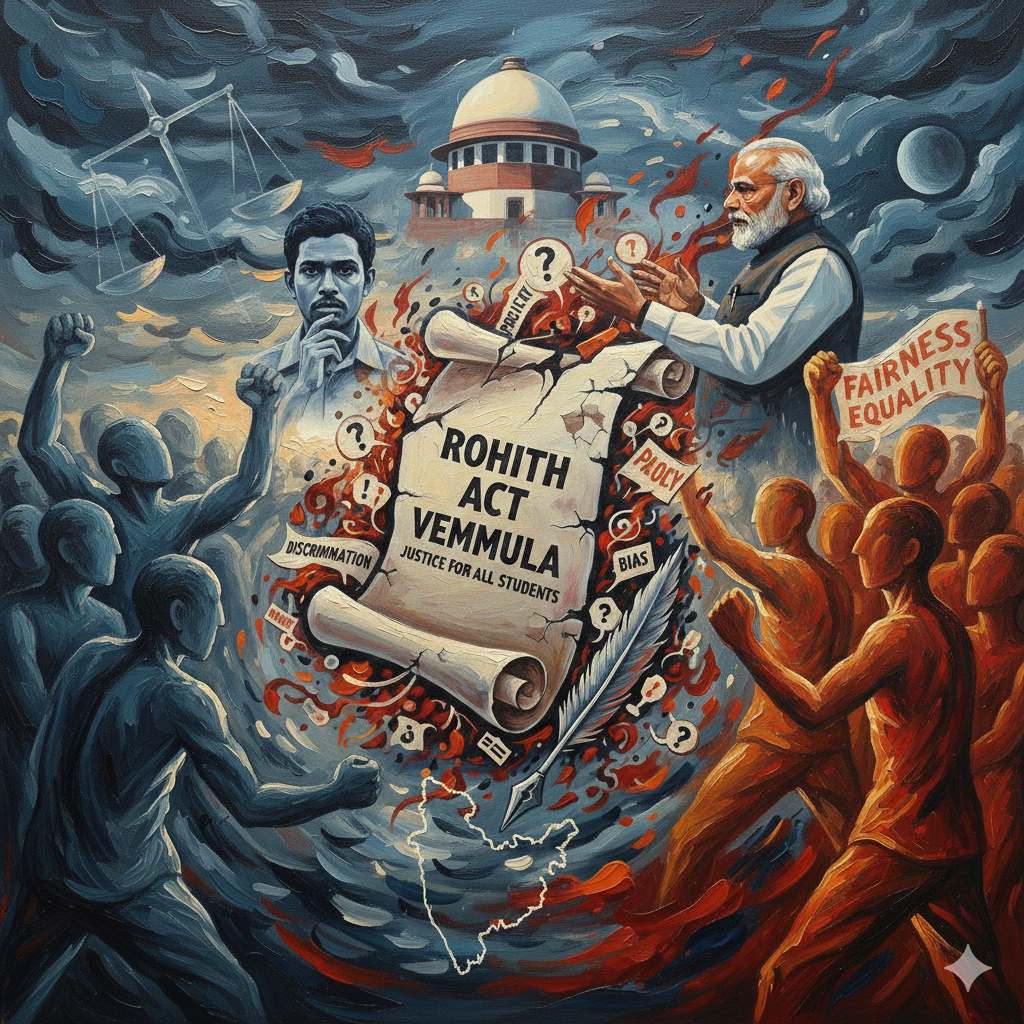
Karnataka's New Rohith Vemula Bill: Does It Reinforce Caste Differences?
Does the Rohith Vemula Bill protect equality—or redraw caste lines? Who is shielded, who is silenced, and who decides guilt? Can justice prevent discrimination without creating new fears? Or does intent collide with impact?
Karnataka Rohith Vemula Bill 2025, caste discrimination, higher education, SC ST OBC minorities, misuse of law, equality debate, general category concerns
Karnataka Rohith Vemula Bill 2025, caste discrimination, higher education, SC ST OBC minorities, misuse of law, equality debate, general category concerns
The Karnataka Rohith Vemula (Prevention of Exclusion or Injustice) Bill, 2025, is a proposed state legislation that aims to mitigate caste-based discrimination in higher educational institutions in the state of Karnataka. Named after Rohith Vemula, a PhD scholar whose suicide in 2016 became a national flashpoint for debates on caste discrimination, this Bill gives people belonging to SC, ST, OBC, and minority groups protection against any verbal or physical abuse based on their religious/ caste identity.
Core Provisions
The Bill covers discrimination against persons from SC (Scheduled Castes), ST (Scheduled Tribes), OBC (Other Backwards Classes), and minority communities in educational spaces.
It mandates penalties for individuals found guilty of discriminatory acts: for first offences, up to 1 year imprisonment and ₹10,000 fine; repeat offences could attract 3 years and ₹1 lakh fine.
Institutions that violate provisions may face ₹1 lakh to ₹10 lakh fines and even the withdrawal of government grants.
Equity committees are to be set up to handle complaints internally, similar to anti-sexual harassment mechanisms.
The proposition of this Bill has sparked debates all over the country. Some support the Rohith Vemula Bill as they perceive it as a legal enforcer of the Right to Equality offered by the Constitution to all the citizens of India. But many critics note that this Bill automatically reinforces the preconceived negative image of the general category.
Caste Realities In India
Many deprived and economically backward communities still face caste, gender, and social discrimination despite the progress that Indian Society has made over the years. From social exclusion of Dalits to the stereotyping of the Tribal communities, these cultural disparities and differences remain relevant even today.
Rohith Vemula's suicide is a testament to the relevance of caste discrimination in modern-day India. Cultural diversity in the country often comes with its shortcomings. What holds significance in one community can be deemed as a disrespectful act in the other. Therefore, these cultural fault lines often prove to be a point of conflict and violence.
How Dominant Narratives Shape Perceptions
The narrative that the Brahmins or the general category as a whole has a prejudice against the "lower castes" often overlooks the diversity of narratives within the communities. This makes the general category vulnerable to any possible misuse of this bill. Proving innocence in these cases is even more difficult, as the preconceived notions often guide the judgment of the media as well as the witnesses.
When Congress introduced Rohit Vemula Bill in Karnataka. BJP didn't oppose it but still gullible voters and IT cell was like, Congress bad, BJP good.
But the question is: How does the State ensure protection of the general category? As much as the former statements regarding the situation of the marginalised communities remain true, the misuse of these legal frameworks is a common practice today.
Conclusion
Although this Bill is a progressive step towards the protection of marginalized communities, serious questions towards the execution and regulation of misuse. The Government of Karnataka has still not been able to answer the questions about how they plan to maintain balance and fairness in cases that will be registered under this law. Therefore, revision of provisions and a clear definition of the clauses are necessary.
Share this article
The link has been copied!
Members Discussion
Your link has expired. Please request a new one.
Your link has expired. Please request a new one.
Your link has expired. Please request a new one.
Great! You've successfully signed up.
Great! You've successfully signed up.
Welcome back! You've successfully signed in.
Success! You now have access to additional content.
What’s Coming Next?
Explore our upcoming features, author interviews, and deep-dives into new policy reforms.