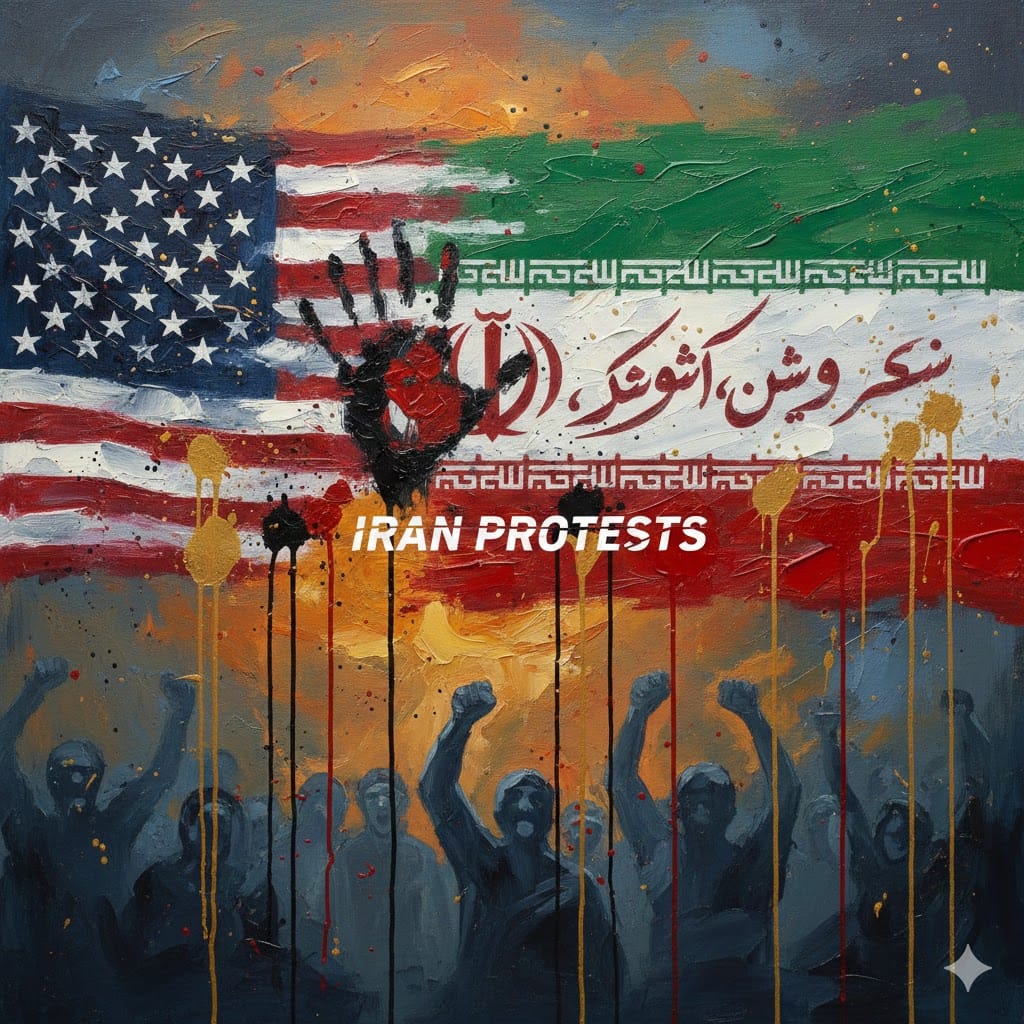
As protests shake Iran, missiles and oil fade into the background. What truly alarms the world is how the regime treats dissent like invasion and fear like policy. Iran’s streets are revealing a security model on the brink, and its collapse could reshape global order.
The ongoing protest in Iran has gained the attention of the World due to the gruesome actions of its controlling authoritarian regime. But as the situation is escalating with US President Donald Trump's plans of intervention, one question always arises: Why is Iran important to the World?
Many dominant perspectives believe that Iran's Global importance lies in its Oil Reserves; others believe that Iran's support of insurgent groups and militias causes unrest in the Middle East, hence, it is important. However, the reality is far more complex.
Why is Iran Important?
Iran today is not just a geopolitical player; it is a fault line between two converging crises: a collapsing rentier-state model and a generational rejection of ideological authoritarianism.
1. Control of Regional Fault Lines
Iran is the geopolitical node of control of the Middle East. It borders Iraq, Afghanistan, and Pakistan, making it one of the most important territories from a security perspective. Any regime that controls the geographical land of Iran has immediate access to some of the major countries in the Middle East.
Another notable prospect is that proxies across Lebanon (Hezbollah), Syria, Iraq, Yemen (Houthis) have deep-rooted connections in Iran, affecting the regional stability. This affects U.S. interests because instability reverberates into global security, terrorism risk, and oil markets.
2. Oil, Energy Markets & Geoeconomics
Iran is a major energy producer and controls strategic waterways (Strait of Hormuz). Even rumors of instability push oil prices up, impacting global markets.
Repeated sanctions by the U.S. have squeezed its oil exports and denied it foreign investment, intensifying domestic strain. The Iranian economy relies heavily on its oil markets and foreign importers, which means that as the sanctions have increased, the economy has become unsustainable. This directly impacts markets worldwide.
3. Nuclear Ambitions and Security Dilemmas
Iran’s nuclear program isn’t only about weapons; it’s a bargaining chip and a security multiplier in Middle East deterrence. The U.S. sees it as a counterforce to allies like Israel and the Gulf states. Iran wants nuclear weapons for deterrence. The regime aims to overcompensate for the domestic instability by deterring the focus to the "nuclear threat" narrative.
According to the popular belief, Iranians support this kind of nuclear expansion, whereas, in reality, Iranians at home are terrified of nuclear escalation, not because they hate technology, but because it means more sanctions and economic ruin.
The Role of A Restrictive Authoritarian State
Historically, Iran was not an Islamic State. It is after foreign invasions that weakened Persia (modern-day Iran) that the State slowly transformed into what it is today. And this is where the fault lines lie. An authoritarian state like Iran functions on systematic control of freedom, information, and the overall narrative. Therefore, any demands by the public opposing the Regime's narrative are treated as a "threat". Suppression based on gender, dress codes, and religious orthodoxy are tools that help in "maintaining" the image of "authority" and "control".
Dear world,
Iran was not a Muslim country.⁰ It was conquered by Islam.⁰ Today, Iranians are fighting for their freedom, and their bravery should hold us all in awe.
In Iran, a street protest is treated with the same seriousness as a foreign invasion. Because the regime’s core fear is not the US military, it is horizontal mobilization (people organizing without clerical mediation).
Conclusion
Iran’s strategic importance does not lie merely in its missiles or its militias, but in the way it has transformed insecurity into a mode of governance. The Islamic Republic does not seek stability; it survives on managed instability. Every protest is treated as a national security breach, every woman’s defiance as ideological sabotage. In securitizing everyday life, Iran has become both a regional disruptor and a domestic pressure cooker. The irony is stark: the same mechanisms designed to protect the state are now accelerating its legitimacy collapse. What unfolds on Iranian streets today is not a human-rights footnote , it is a global security signal.
Share this article
The link has been copied!
Members Discussion
Your link has expired. Please request a new one.
Your link has expired. Please request a new one.
Your link has expired. Please request a new one.
Great! You've successfully signed up.
Great! You've successfully signed up.
Welcome back! You've successfully signed in.
Success! You now have access to additional content.
What’s Coming Next?
Explore our upcoming features, author interviews, and deep-dives into new policy reforms.