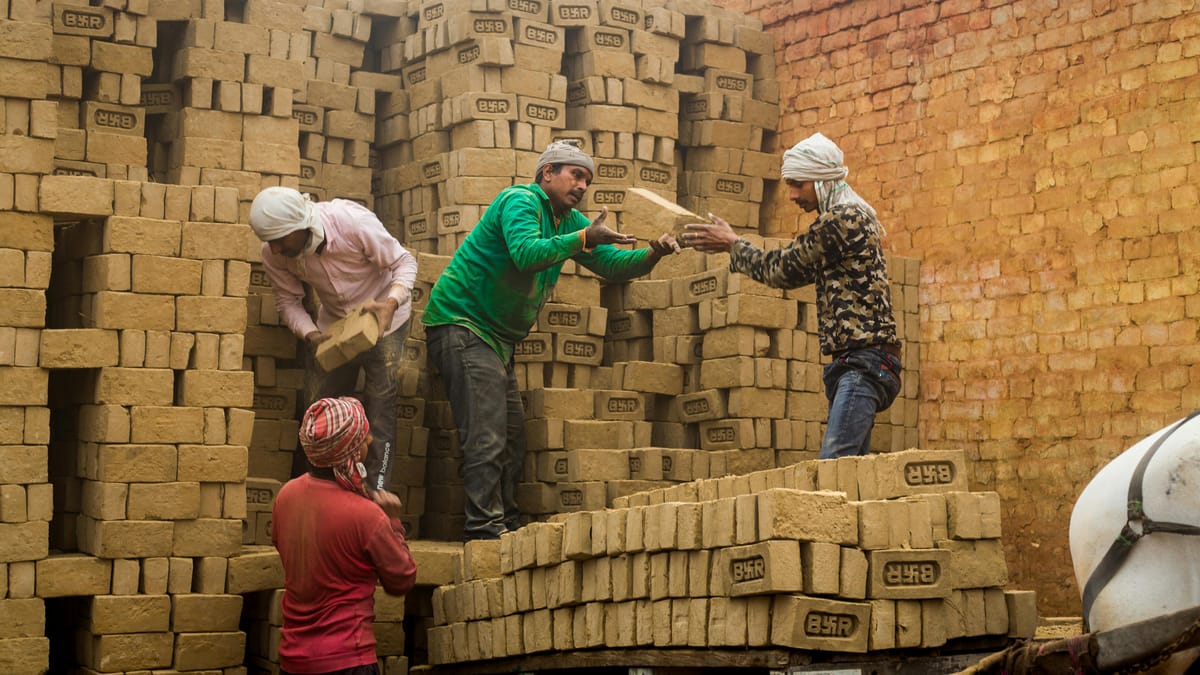
Interview: The Deteriorating Condition of Migrant Labourers In Delhi
They build the classrooms but never sit in them. They watch lessons unfold through windows they cannot enter.
Inside the same institution, two worlds exist, one chasing dreams, the other surviving reality.
“घर तो हम बहुत साल पहले ही छोड़ आए थे, अब तो जहाँ काम, वहीं घर है।”
“Home? That we had left a long time ago, now home is where work is.”
An institution is a home to numerous conflicting stories. It functions not merely as a site of education, but at times as a space that reproduces inequalities and reinforces hierarchies. Within its boundary exists a consequential paradox, one that sustains a rigid divide between those who study and those who perform labour to keep the institution running.
Daily wage construction workers, gardeners, maintenance and sanitation staff form the foundation of the everyday function of the colleges in the University of Delhi. It is their hard labour that makes it possible for over 2,000 students to participate in their academic and extracurricular activities every day. For the students, the institution serves as a space to enhance their skills and capabilities.
Pooja, a student in the Department of Journalism, Kalindi College, says,
“College is a space that nourishes you in ways that go unnoticed by people. It is a home in more ways than one”.
Yet, within the same institution, people work for entirely different reasons. For some, it is a means of supporting a child’s education; for others, it is a way to pay mounting medical bills. And for a few decades of association have created an emotional attachment to a space that is now like a second home to them.
“I came to Delhi at the age of 6, went to school till 6th class, became a construction worker at the age of 14 and have been working ever since. Most of the places I have worked in require us to work for 8-9 hours per day. As I am getting older, it is getting difficult to engage in manual labour, but I need to support the education of my 7 daughters. I want them to study in a college like this one day” said Worker 1 in the interview.
But do they know their rights? Are they aware of the labour protection laws meant to safeguard them?
The answer is no, and what unfolds within an institution is not an isolated reality, it is a reflection of a larger pattern.
Delhi is a hub for internal migrant work, drawing people from Bihar, Uttar Pradesh, Madhya Pradesh, etc., in search of better opportunities. However, the opportunities remain unequal. UNICEF’s 2024 report on Child Labour and Schooling in India (2024 Global Estimates of Child Labour in Figures | International Labour Organisation, n.d.) highlights how most of these migrant workers experience disrupted access to education. This exclusion is not incidental; it limits access to better work and restricts awareness of rights, effectively reproducing cycles of vulnerability across generations.
Elaborating on the inclusion of children in their work, one of the construction workers at the college explains,
“Including our children in this line of work is not our choice. But when money is limited, boys are included in work, while girls are married off to take care of the household.”
Educational institutions encompass all these stories, both for students as well as workers. They sustain a parallel reality where education remains visible, but not accessible. The question, then, is: do these institutions work on extending the knowledge they impart beyond the classrooms? Are the workers and labourers provided with basic living amenities inside the campus? Or does the idea of inclusion remain merely a theory?
People can have different experiences in the same space and at the same time. What serves as a space for growth and improvement for a student is, for others, it is a space that ensures daily survival. As students sit under fans and air-conditioning, preparing for a better future in relative comfort, labourers build and maintain these very spaces, often in scorching heat, biting cold, and muddy rains, regardless of their own conditions. What is a home full of aspirations for someone, is the only hope of survival for others.
Share this article
The link has been copied!
Members Discussion
Your link has expired. Please request a new one.
Your link has expired. Please request a new one.
Your link has expired. Please request a new one.
Great! You've successfully signed up.
Great! You've successfully signed up.
Welcome back! You've successfully signed in.
Success! You now have access to additional content.
What’s Coming Next?
Explore our upcoming features, author interviews, and deep-dives into new policy reforms.