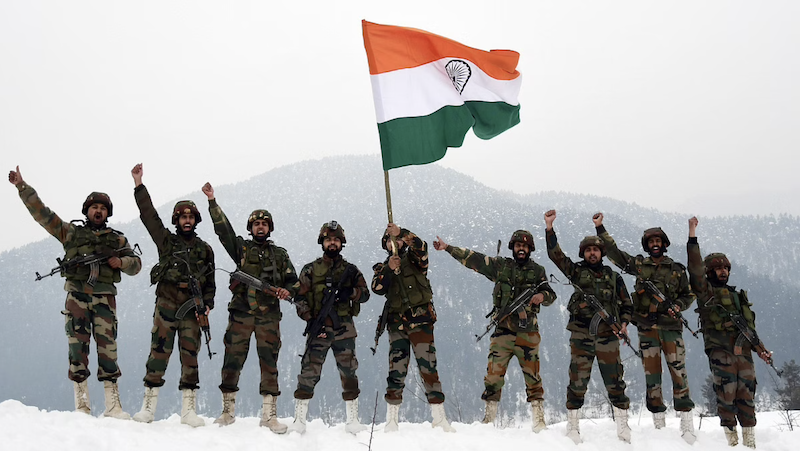
For years, India fought terrorism without a single unified doctrine, until now.
With PRAHAAR, a zero-tolerance strategy targeting state-sponsored terror, ISIS, Al-Qaeda, cyber, and CBRNED threats, the rules of engagement have changed.
On 23 February 2026, the Ministry of Home Affairs (MHA) of India unveiled PRAHAAR, the country’s first unified national anti-terror and counter-terrorism policy and strategy. With a clear stance of non-cooperation on State-sponsored terrorism, global networks like Al-Qaeda and ISIS, and CBRNED and cyber threats.
Background
With a long-standing history of having faced state-sponsored terrorism, India aims to make centralised laws and policies that address terror outfits like ISIS, Al-Qaeda, Lashkar-e-Taiba, and internal insurgent groups that cause unrest across the borders of the country. PRAHAAR has been launched with the vision of addressing and neutralising terrorist activities while keeping the safety and harmony of citizens as the top priority.
Operation Sindoor and Operation Kellar have been the foundation grounds for PRAHAAR, where India's new no-compromise stance on terrorism takes precedence.
What Is PRAHAAR? — Definition & Core Concept
PRAHAAR is an acronym representing the core principles of the policy:
Prevention of terror attacks
Response to threats with speed and proportionality
Aggregating internal capacities for coordinated action
Human rights and rule-of-law processes
Attenuating conditions that enable terrorism, including radicalisation
Aligning international counter-terror efforts
Recovery and resilience through a whole-of-society approach
It is designed as a holistic framework that integrates counter-terrorism, counter-radicalisation, cybersecurity, and multi-agency coordination under a single, proactive national strategy.
The policy places the prevention of terror attacks as the core priority. Intelligence gathering, real-time data sharing, and anticipatory disruption of terror networks are prioritised.
2. Swift & Proportionate Response
It emphasises a tiered, calibrated response: local police as first responders, supported by state units and national forces like the National Security Guard (NSG) for major counter-terror tasks.
3. Multilayered Coordination
PRAHAAR institutionalises coordination across all levels of government — central, state, local — and among agencies such as:
Multi-Agency Centre (MAC)
Joint Task Force on Intelligence (JTFI)
Intelligence Bureau (IB)
National Investigation Agency (NIA)
These mechanisms aim to ensure seamless operational collaboration and unified threat response
Conclusion
It is the first time in years that India has taken a legal stand against terrorism. With the uncertain nature of terror outfits on the borders as well as inside the country, the country must have designated policies for such activities. Therefore, PRAHAAR is truly a revolutionary step in the way India has been dealing with terrorism for years.
Share this article
The link has been copied!
Members Discussion
Your link has expired. Please request a new one.
Your link has expired. Please request a new one.
Your link has expired. Please request a new one.
Great! You've successfully signed up.
Great! You've successfully signed up.
Welcome back! You've successfully signed in.
Success! You now have access to additional content.
What’s Coming Next?
Explore our upcoming features, author interviews, and deep-dives into new policy reforms.