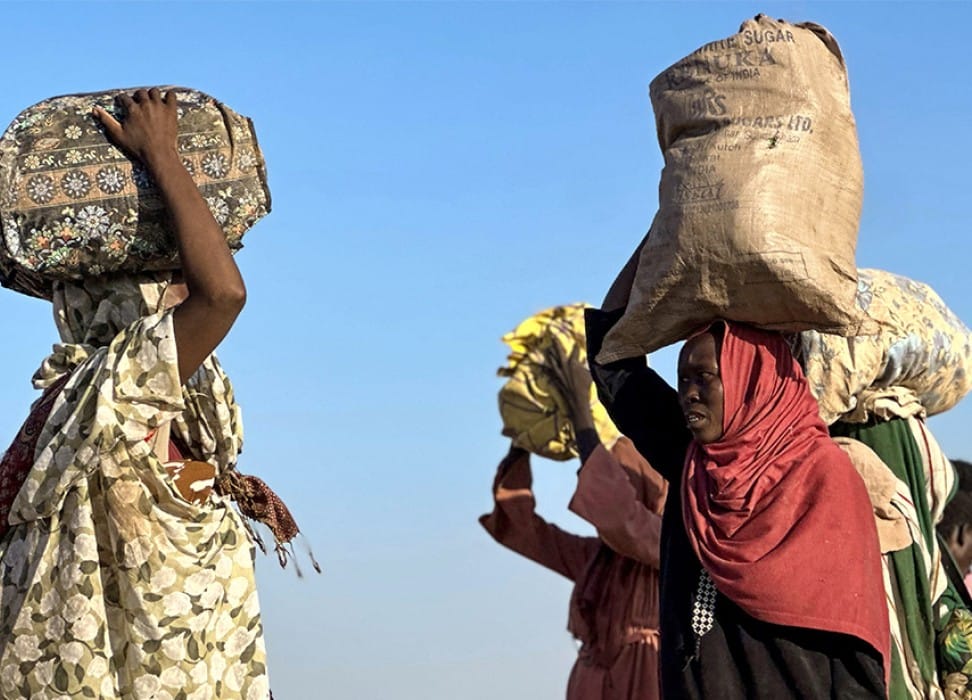
6,000 killed in El-Fasher in three days. 13.6 million displaced. 40,000+ dead. RSF war crimes, famine, and collapsed hospitals, Sudan is not a headline, it is a catastrophe. As the world debates geopolitics, civilians flee and accountability fades into silence.
Sudanese Civilians amid the displacement crisis. (Source)
Sudanese Civilians amid the displacement crisis. (Source)
What does one imagine when the headlines of their daily newspaper say "6000 people died within 3 days"? Most readers skip the story as if it were just another exaggerated headline.
But the civilians of Sudan are living this reality every day. What once used to be a country known for its flourishing markets and beautifully painted mosques is now nothing but a pile of dead bodies and burning houses.
El-Fasher: The Media Blindspot
According to a February 2026 United Nations report, the paramilitary Rapid Support Forces (RSF) killed at least 6,000 civilians over just three days (25–27 October 2025) during its assault on el-Fasher in Darfur, a city once one of the last army strongholds.
The UN report stated that ~4,400 people were killed inside el-Fasher, and ~1,600 more were killed along exit routes as people fled. The report has documented proof of executions, torture, sexual violence, and attacks on civilians, actions that “amount to war crimes and possible crimes against humanity.” Human Rights Watch and the UN Office of the High Commissioner for Human Rights (OHCHR) also highlight systematic abuses by RSF fighters and allied militias in Darfur.
But the question is: Why have these events not been a Global issue? Why is the media silent?
Little to no media coverage on the global stage has proven to be another pivotal reason for the suffering of the civilians of Sudan. The media has sidelined the suffering of the Sudanese civilians and replaced it with stories that have no relevance to the struggle of the common man. Advocacy is no longer a characteristic of the media.
Displacement Crisis: No longer just a power struggle
Sudan now faces the world’s largest displacement crisis in 2026, a crisis bigger than in Gaza and Ukraine. An estimated ~13.6 million people have been displaced, with ~9.3 million internally displaced and ~4.3 million refugees in neighbouring states. This displacement has overwhelmed aid systems and contributed to outbreaks of cholera, malaria, dengue, and measles
The Health infrastructure in Sudan has collapsed, with 201 verified attacks on health facilities reported, resulting in ~1,858 deaths and ~490 injuries to health workers and patients.
The World Health Organization (WHO) and aid agencies have reported over 40,000 deaths, which is just an estimated number. The question that is not being asked here is- Who will take accountability for these "War Crimes"? If war crimes are documented, where is the action?
In reality, this is not just a war; it is a systematic structural breakdown of Sudan. And these organisations have made a spectacle out of the suffering of the civilians. The efforts made to stop the war seem half-hearted and just for image maintenance.
Doctors Warn: Daily Deaths Among Civilians in Sudan
Medical staff in El Fasher, North Darfur, report that patients and injured civilians are dying daily in hospitals and detention centers, especially in the Al-Rashid dormitory at El Fasher University, where hundreds await care.… pic.twitter.com/Fc1MCnceUQ
Sudan’s foreign ministry has framed the conflict as resisting foreign interference, claiming the war’s impact affects broader regional stability, a measure of how entangled geopolitics has become. Reuters has reported that countries like Ethiopia are funding external support networks and training RSF fighters.
Due to this external interference, the civilians have been forced to flee to the neighbouring countries, where they are still struggling for basic amenities like food and healthcare.
Sudan's condition is deteriorating with time. Men, women, and children are all stuck in the cycle of war and death. Innocent lives, who have no relation to the war, are still being affected every day. The question is no longer whether Sudan can survive this war. The question is whether the world can justify watching it unravel.
Share this article
The link has been copied!
Members Discussion
Your link has expired. Please request a new one.
Your link has expired. Please request a new one.
Your link has expired. Please request a new one.
Great! You've successfully signed up.
Great! You've successfully signed up.
Welcome back! You've successfully signed in.
Success! You now have access to additional content.
What’s Coming Next?
Explore our upcoming features, author interviews, and deep-dives into new policy reforms.