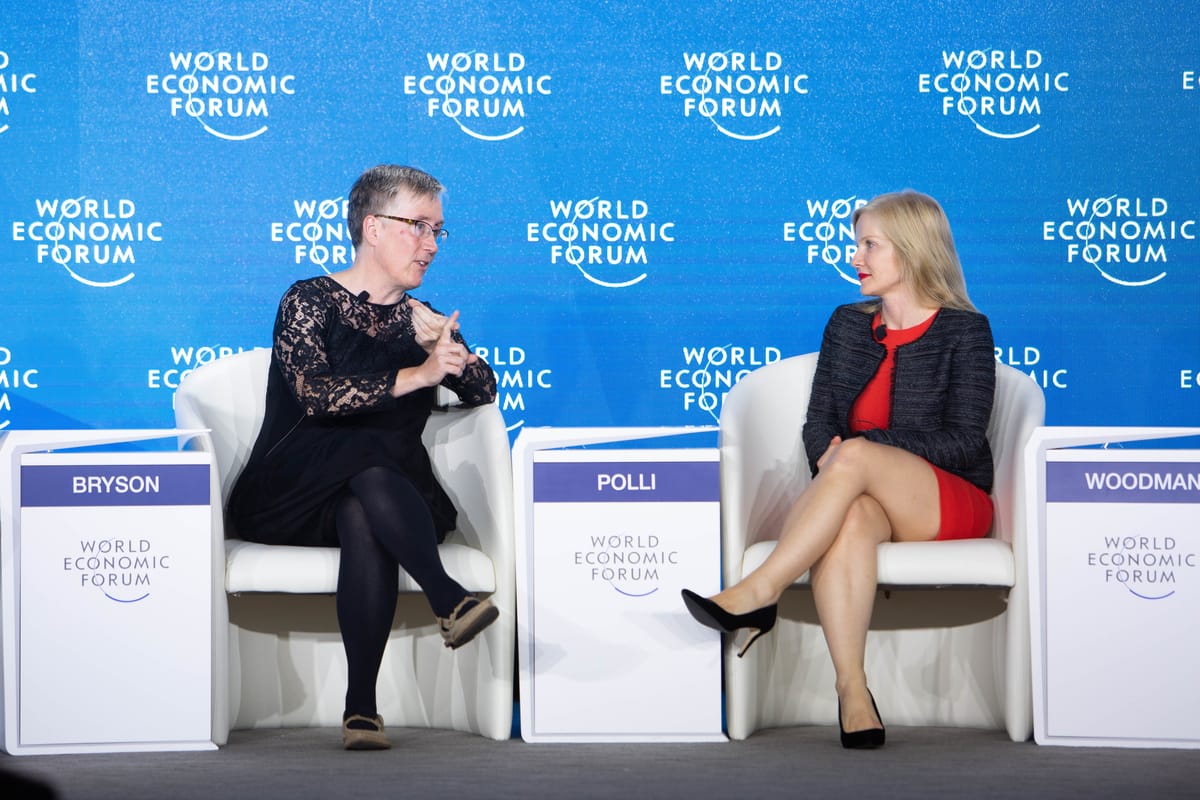
World Economic Forum, Public domain, via Wikimedia Commons | Credit: World Economic Forum
World Economic Forum, Public domain, via Wikimedia Commons | Credit: World Economic Forum
In line with its longstanding annual calendar, the World Economic Forum’s Summit flagged off on 19th of January at Davos. With political stalwarts, business leaders and economists from around the world flocking to the Swiss town, the global attention has once again shifted to the proceedings shaping this landmark convening. Amidst the swirl of negotiations, one question remains pertinent: to what extent has the question of climate justice been adequately addressed? With billionaires dismissing climate-action as ‘aberrations’, it’s evident that this agenda has been sidelined in favour of other strategically expedient priorities. It’s important to note however, that the systems-level decisions being taken now will shape the financial architectures and energy transition mechanisms that are poised to determine the trajectory of climate action not only in the immediate future, but for decades ahead.
Trump's Nuclear Push and "Green New Scam" Dismissal
President Donald Trump’s affirmative stance on substantially ramping up nuclear energy signals a spectrum of potential risks that merit scrutiny. This was corroborated by a later press release of the US Department of Energy announcing that Trump would be unleashing ‘America’s next nuclear renaissance’. In his speech, he also reiterated his consistent criticism of wind-power, mocking Europe’s heavy reliance on the technology and labelling it as money-losing.
In an ironic turn of events, when renewable energy sources now account for 20% of net electricity consumed in the US, Trump’s labelling of policies aimed at combating climate-change and promoting renewable energy alternatives as ‘Green New Scam’ highlights a stark contradiction between reality and rhetoric. Trump’s presidency has increasingly begun to represent a shift towards billionaire-driven politics, with his election agenda championing continued reliance on fossil fuels. In the same vein, the World Economic Forum’s ‘Global Risks Report 2026’ foreshadows the impending climate breakdown, while failing to address the corporate force that fuels it.
Private Jets Touch Down at Davos While Transport Sustainability Takes a Back Seat
Many of the global leaders were seen arriving at Davos in their private jets, with the frequency of such flights exhibiting a marked increase in recent years. The report titled, 'Davos in the Sky' has revealed that private jet flights to Davos have tripled since 2023 and increased by 10% compared to last year. Greenpeace in Central and Eastern Europe (CEE) estimates that 70% of jet routes could have been feasibly covered by trains within a single day. Another article in India Today revealed that an estimated five private jets descended every hour at Zurich International Airport between 19th and 20th January alone. Over the three-day period from 19 to 21 January, more than 821 jets touched down at Zurich Airport. It's noteworthy that many of the private jets to Davos were short-haul flights, covering distances less than 750 km, which could have been ground transport alternatives.
Research conducted by UCL’s Department of Geography found that private jets are responsible for five to 14 times more pollution per passenger than their commercial counterparts. Back in 2019, the organisers of the forum announced that all carbon emissions attributable to air travel to and from the forum were fully offset. But in recent times, this concept has failed to elicit global credibility, as major corporations often end up investing in ‘junk' carbon offsets, defeating the very goal of delivering meaningful climate benefits.
It’s a striking paradox that events dedicated to the broader discourse on sustainability and global economic welfare are shaped by surges in emissions, even though climate action and decarbonisation are positioned at the helm of the global agenda.
Deafening Silence Surrounding Climate Action at Davos
The notable absence of concrete discourse on climate sustainability and actionable climate policy at this year’s summit puts a big question mark over the credibility of its stated theme, i.e. ‘Spirit of Dialogue’. While sharp rhetoric and spirited remarks aimed at garnering media sensitisation occupy centre stage, the pressing question is to what extent these exchanges amount to concerted dialogue. This year, the focus drifted to issues that are undeniably urgent but are arguably either derivative of or intensified by climate risk.
Why Can Davos No Longer Ignore the Fossil Fuel Debate?
It’s undeniable that the continued reliance on fossil fuels has been one of the primary catalysts behind global warming, environmental degradation, having widespread ramifications for infrastructure, public health and national economies and multiple other sectors. This risk has given way to the adoption of more renewable alternatives, which are cheaper, easily deployable, accessible and more resilient. Transitioning to renewable fuels reduces import reliance in addition to stabilising global market prices. Andrew Forrest, chairman of Fortescue Metals Group Ltd., argued in an interview at Davos that it’s high time for the world to shift from ‘net-zero’ to ‘real zero’ by putting an end to the burning of fossil fuels altogether.
Fossil fuel lobbyists still dominate political discourse despite these stark realities. This was evident at the last COP 31, where every one of 25 delegates represented fossil fuel interests. Similarly, the COP 28 in Dubai witnessed the unprecedented presence of an estimated 2400 delegates with direct or indirect affiliations to the fossil fuel industry. But in the recently concluded World Economic Forum’s summit, world leaders have shifted the climate conversation from ending fossil fuel use to a clean transition through renewable alternatives. Only through binding global action can the promise of renewables translate into real resilience for vulnerable economies and communities.
Share this article
The link has been copied!
Members Discussion
Your link has expired. Please request a new one.
Your link has expired. Please request a new one.
Your link has expired. Please request a new one.
Great! You've successfully signed up.
Great! You've successfully signed up.
Welcome back! You've successfully signed in.
Success! You now have access to additional content.
What’s Coming Next?
Explore our upcoming features, author interviews, and deep-dives into new policy reforms.