Chhath Puja Celebrations in the Capital Challenge Yamuna's State
Amid Chhath Puja, Delhi faces a worsening Yamuna River crisis as devotees enter highly contaminated, foam-blanketed waters despite health warnings. The severe pollution, driven by untreated sewage and industrial waste, remains a major political flashpoint and poses serious health risks.
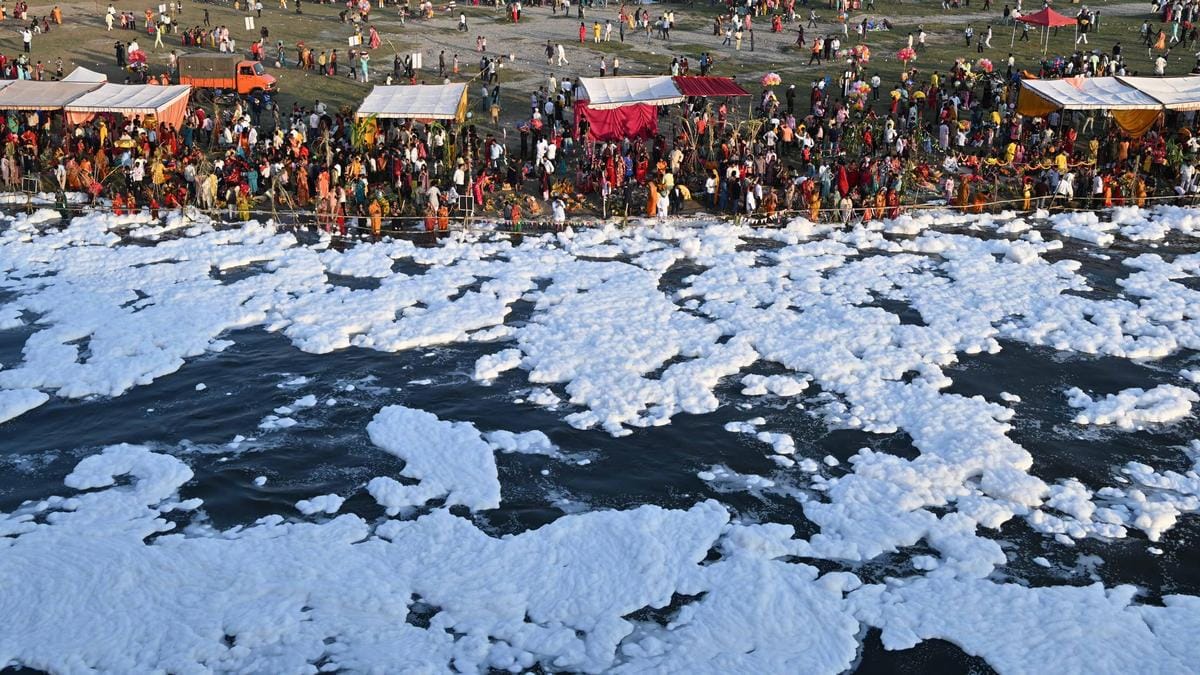
Devotees along a Foamy Yamuna Bank in Noida on Nov 15. (Credit: The Hindu)
Devotees along a Foamy Yamuna Bank in Noida on Nov 15. (Credit: The Hindu)
After a bout of severe air pollution that Delhi is still recovering from, the capital now faces a new issue: a worsening Yamuna River crisis amid the annual Chhath Puja celebrations, as thousands of devotees wade into the highly contaminated river to offer prayers to the sun god. Despite repeated warnings from the Delhi High Court about the health risks, the river’s condition remains a major flashpoint in this city's political landscape.
Yamuna's Polluted State
The Times of Indiahighlights some of the polluters as untreated sewage (Najafgarh drain, a major source), industrial waste, and agricultural runoff. During the winter months, the river is frequently blanketed by thick, white, toxic foam, caused by laundry detergents and phosphates from fertilizers. The Telegraph reports that fecal coliform levels in the river far exceed safe limits, reaching up to 15 times the maximum permissible level at some monitoring stations. Biological oxygen demand (BOD) also spikes sharply as the river flows through the capital, indicating a severe lack of oxygen for aquatic life.
Health Risks for Devotees Celebrating Chhath in the Yamuna
None of Delhi's major Yamuna Ghats meet government bathing water standards. The Delhi High Court has repeatedly upheld bans on the Chhath Puja celebrations along the riverbanks, warning that devotees could fall seriously ill from contaminated water. Despite these warnings, many devotees continue to enter the river driven by faith. Some have claimed that their devotion itself would save them from ill effects, while others are simply apathetic to the health risks.
"I don't bother about the pollution [...] The mother goddess will take care of all our troubles"
Some of the possible health issues flagged so far are folliculitis, dermatitis, and various fungal infections on the skin; typhoid, hepatitis A or E, giardiasis, and cholera if water is ingested; and heavy metal exposure, which can adversely affect the liver, kidneys, and nervous system.
Exposure to the water poses significant health risks, according to doctors, and children, pregnant women, the elderly, diabetic patients, individuals with open cuts or wounds, and those with weakened immune systems are at a significantly higher risk.
For those observing religious practices at the river, it is strongly advised to consult official government directives and reputable national and/or local resources to identify designated and safer ghats.
No Ghat In Delhi Is Fit For Bathing As Chhath Arrives, But 3 Come Close
(Caption: October satellite images (October 2-22) were used because November's smog distorts satellite readings and river conditions after the monsoon remain broadly similar through Chhath.) pic.twitter.com/TnReDjdAgN
Political Controversy and Government Intervention to Improve the Yamuna's State
The BJP, under CM Rekha Gupta's aegis, has claimed credit for cleanup efforts. However, recent evidence of pollution has sparked a political row between the incumbent party and several opposition parties, especially after hundreds of dead fish were found in the Yamuna near Sonia Vihar. BJP's Parvesh Verma (also known as Pravesh Sahib Singh), Delhi's water minister, alleged AAP workers dumped them to discredit river cleaning; AAP denied this as a "false narrative" and demanded an enquiry.
To curb Chhath celebrations on floodplains, the DDMA invoked a 2015 NGT ban on waste; the Delhi government provided over 1,000 alternative sites and artificial ponds. Previously, authorities used anti-foaming agents and nets to clear toxic scum, though these only represent a temporary recourse, and water quality remains unaddressed.