Delhi Cloud Seeding Trials: New Solution To The Old Toxic Air Problem?
Delhi is conducting cloud-seeding trials with IIT Kanpur to explore whether artificial rain can reduce hazardous air pollution. But can the technology deliver the rainfall needed to clear the capital's toxic air?
With Diwali celebrations pushing Delhi's AQI above 400 and into the "Severe" category, authorities are seeking new ways to reduce pollution levels. Cloud seeding has emerged as a potential solution for inducing artificial rainfall and clearing airborne pollutants. The Delhi Government, in collaboration with IIT Kanpur, has been conducting cloud-seeding trials to assess whether the technology can provide temporary relief.
What is Cloud Seeding?
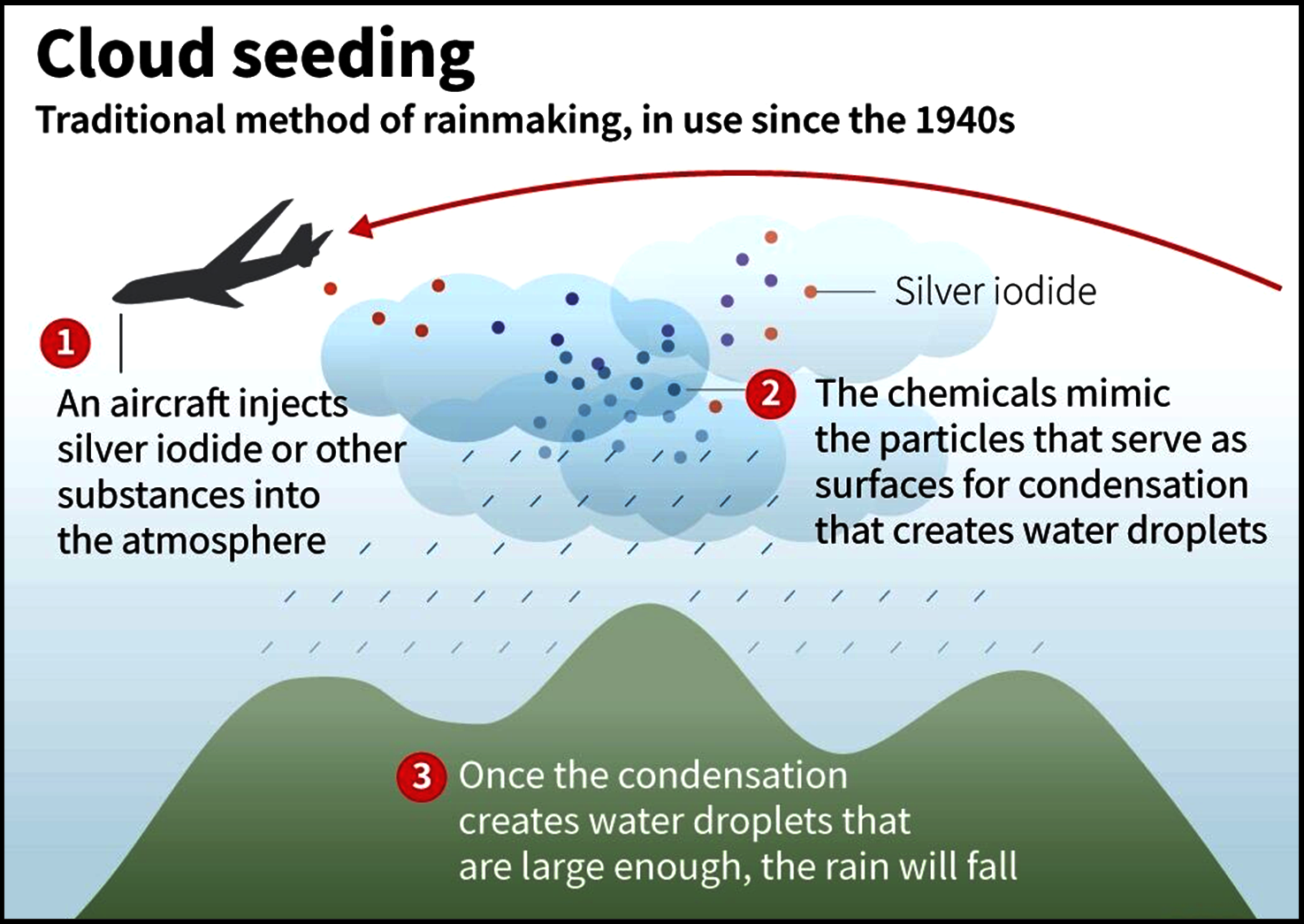
Cloud seeding is a weather-modification technique used to encourage rainfall by introducing tiny particles into existing clouds. According to the Desert Research Institute (DRI), the process involves dispersing substances such as silver iodide, which has a crystalline structure similar to natural ice, into suitable clouds. These particles act as nuclei around which water droplets or ice crystals can form and grow. As the droplets or crystals become sufficiently large and heavy, they may fall to the ground as precipitation. However, the technique doesn't create clouds from nothing; it requires existing clouds with sufficient moisture, and even then, there are no guarantees of rain.
Illustration of Cloud Seeding Process. (Credit: Drishti IAS)
What is Delhi doing?
On November 5, PTI reported that the Delhi government (with Environment Minister Manjinder Singh Sirsa at the helm) conducted two rounds of cloud-seeding trials at altitudes of 30,000 metres near Indira Gandhi International Airport over the preceding 15 days, seeking to evaluate artificial rain as a possible measure against rising air pollution. Additional trials are anticipated following Diwali and Chhath.
NDTV notes that the cloud seeding project was first rolled out last year under a collaboration between the Delhi government and IIT Kanpur, but it didn't yield results. This year's efforts are yet to bear fruit, but all eyes remain on the trials.
Can Artificial Rain Actually Reduce Delhi's Air Pollution?
China’s extensive cloud-seeding programme illustrates how weather modification might ease water shortages and pollution. According to the BBC, the March 2025 Spring Rain operation produced 31 million tonnes of precipitation across 10 drought-prone regions.
For Delhi, these shifts suggest that cloud seeding merits attention, especially as technological advances could enable more precise work. Yet China’s reported outcomes do not provide definitive proof. Researchers have questioned whether the extra rainfall claimed by officials can be verified independently. Whether the method yields measurable results in Delhi remains uncertain.