Kulgam Encounter: Indian Army Urges Latief Bhat to Surrender in a New Video
Lashkar-e-Taiba commander Latief Bhat, the last active local militant in South Kashmir, was killed in a Kulgam encounter after refusing to surrender. The operation successfully neutralised a key figure responsible for recent attacks on security personnel and non-locals in the region.
CCTV footage shows Latief Bhat and his aide's reconnaissance. (Credit: The Times of India)
CCTV footage shows Latief Bhat and his aide's reconnaissance. (Credit: The Times of India)
Lashkar-e-Taiba (LeT) commander Latief Bhat, 22, the last active local militant in South Kashmir, was killed in a Kulgam encounter after refusing surrender offers. Carrying a ₹15 lakh bounty, he had taken refuge in a mosque. Bhat, a prime suspect in the November 11 CRPF checkpoint attack in Akhran, Kulgam, and the July killings of a constable and two migrant workers in Anantnag and Kulgam, was neutralised today.
The Joint Operation that Led to the Encounter
The operation targeting Bhat commenced in the early hours of Wednesday in Zangalpura, Kulgam, based on precise intelligence inputs. An X post by the Chinar Corps of the Indian Army confirmed a joint operation involving the Indian Army, Jammu and Kashmir Police, and Srinagar CRPF.
After being cornered inside a mosque in Zangalpura village, security forces, including the Kulgam Senior Superintendent of Police (SSP) Anayat Ali, engaged in a lengthy video call with Bhat to persuade him to surrender. Despite repeated appeals, he refused, saying he was ready to meet Allah, and opened fire on troops around 2:45 AM, reports The Indian Express. Security forces exercised maximum restraint to avoid damaging the religious structure before ultimately neutralising him. (Credit: The Hindu)
Who Was Latief Bhat?
Bhat, a former carpenter from Kulgam, according to The Hindu, had joined the militant ranks exactly one year before his death on November 18, 2025. Operating under the LeT proxy, The Resistance Front (TRF), he quickly became one of the most wanted terrorists in the valley.
Known for his "shoot and scoot" tactics, Bhat had successfully escaped security cordons on at least three previous occasions, including an encounter on November 16, in which his associate, Umar Nisar Dar, was killed in Laroo, Kulgam.
Impact on Kulgam's Regional Security
The elimination of Latief Bhat is being viewed as a major success for security forces in Jammu and Kashmir, according to police officials. Bhat was the only active, trained local terrorist operating in South Kashmir. His death effectively dismantles a key module responsible for a string of attacks aimed at disrupting peace and targeting non-locals and security personnel in the region. (Credit: NDTV)
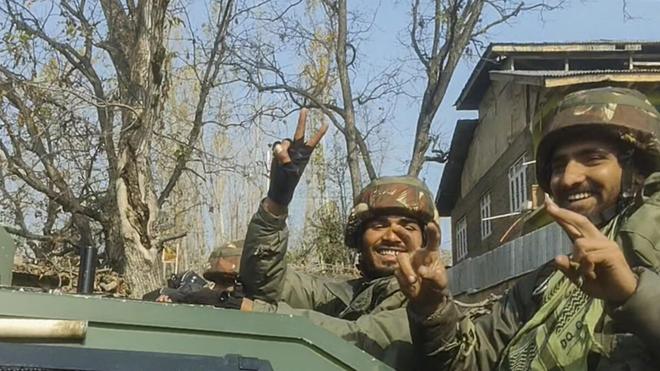
Security Personnel after the Encounter. (Credit: The Hindu)