Quad Leaders Meet in Manila, Announcing Maritime Drills, Mineral Deals and an AI Fund
Modi, Trump, Albanese and Takaichi met in Manila for the first Quad summit in two years, announcing a 2027 joint maritime exercise, new critical mineral deals, an AI fund and a business forum.
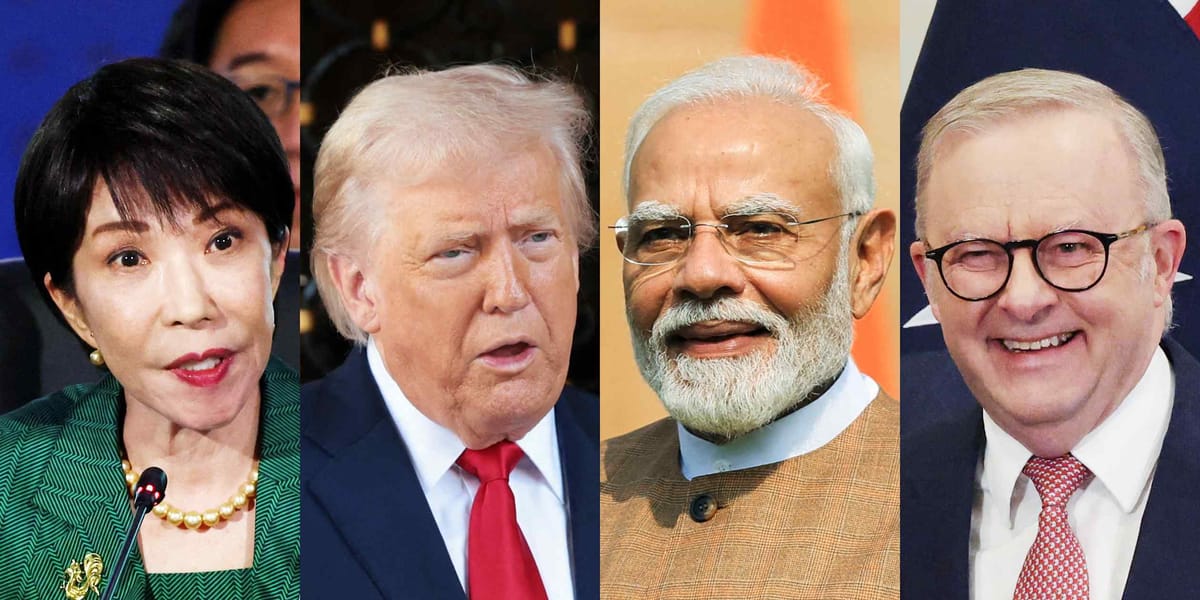
Quad leaders from left: Japanese Prime Minister Sanae Takaichi, U.S. President Donald Trump, Indian Prime Minister Narendra Modi and Australian Prime Minister Anthony Albanese (Source photos by Reuters).
Quad leaders from left: Japanese Prime Minister Sanae Takaichi, U.S. President Donald Trump, Indian Prime Minister Narendra Modi and Australian Prime Minister Anthony Albanese (Source photos by Reuters).
Prime Minister Narendra Modi, US President Donald Trump, Australian Prime Minister Anthony Albanese and Japanese Prime Minister Sanae Takaichi held the seventh Quad Leaders Summit in Manila on Tuesday, on the sidelines of the ASEAN gatherings. It was the grouping's first leaders' meeting in two years and Trump's first Quad meeting. India had planned to host last year, but the summit did not happen because Washington gave no clarity on Trump's visit. Modi noted that officials of the four countries first met in Manila in 2007 and restarted the dialogue there in 2017, and called the Quad a constructive and trusted partnership. Earlier in the day he attended the 23rd ASEAN-India Summit and the 21st East Asia Summit, and met Philippine President Ferdinand Marcos Jr, Singapore's Lawrence Wong and Thailand's Anutin Charnvirakul.
Maritime Surveillance, Cables and Cyber
The leaders launched an Indo-Pacific Maritime Surveillance Collaboration to improve information sharing and awareness of activity at sea. In 2027, their P-8 and P-3C patrol aircraft are due to fly a joint exercise, the first in a Quad context. They also welcomed progress on the Quad Partnership for Cable Connectivity and Resilience, with Australia raising its contribution to cover power and undersea cables in the Indian Ocean, and announced closer cooperation on cybersecurity.
Critical Minerals, AI and Business
Trump said the four countries have signed new critical minerals agreements so that none is vulnerable to coercion by a single foreign supplier, and that the US would catch up with China on rare earth production within ten months. He also said the Quad is spending more than $85 million to widen access to trusted AI systems across the region through a new AI Accelerator. The leaders announced a first Quad Business Leaders Forum, which India's foreign ministry says Mumbai will host in 2027.
The China Question, Left Unspoken
The joint statement opposed unilateral actions to change the status quo by force or coercion and expressed grave concern over economic coercion, including arbitrary export restrictions. It named no country, though the US and Japan have both criticised China's limits on rare earth exports. Scott Lucas of University College Dublin told Al Jazeera the meeting showed the Quad still has a functioning relationship after the strain caused by Trump's tariffs on India, though he would not call it an alliance. Trump now travels on to China, where he is expected at the APEC forum in Shenzhen. Foreign Secretary Vikram Misri said Modi's message at all three meetings was that the world needs peace, stability and predictability.