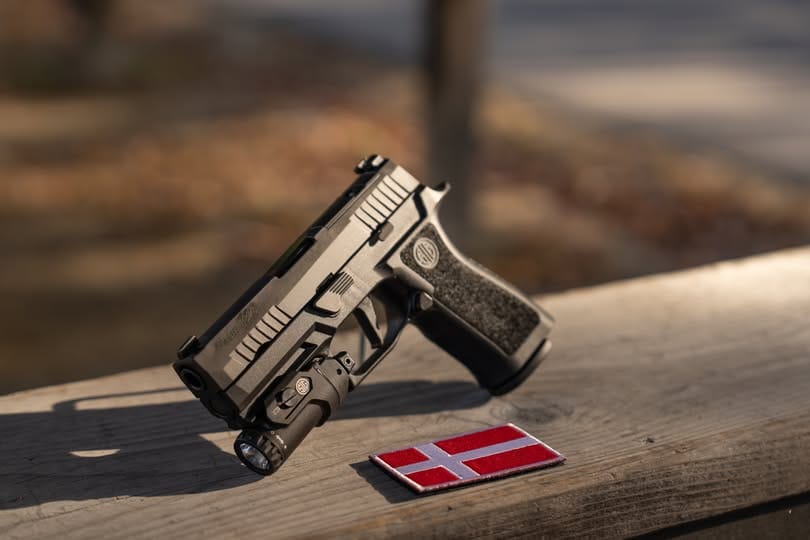
The Gun that Fires Itself? The Controversy Around America’s SIG P320
Lawsuits, injuries, and unanswered questions- the journey of the SIG Sauer P320 from its launch to its adaptation as the official Service Pistol of the US Military. What is the reality behind the controversial handgun?
The SIG Sauer P320 pistol, adopted by the U.S. military in 2017, has become the subject of lawsuits and safety debates after multiple reports of unintended discharges
The SIG Sauer P320 pistol, adopted by the U.S. military in 2017, has become the subject of lawsuits and safety debates after multiple reports of unintended discharges
It was an ordinary moment for Officer Vincent Sherpis before duty. As the Stamford Police Department’s Special Response Team was preparing for a mission, Sherpis was loading equipment into the back of his vehicle. In the routine rhythm of pre-deployment checks, nothing seemed unusual- until his holstered SIG P320 slipped, struck the ground, and the moment changed his life forever.
The silence was shattered, and the pistol had fired.
But Sherpis had never touched the trigger.
And the question that followed the gunshot has now become one of the biggest weapon controversies of all time: How did the gun fire itself?
Background: The Problematic Origins of The SIG Sauer P320
The story of the SIG Sauer P320 actually began with an earlier handgun called the SIG Sauer P250, introduced in 2007. The P250 experimented with a modular concept where the internal firing mechanism could be removed and placed into different frames. However, the P250 used a hammer-fired double-action system, which many shooters found less appealing compared to newer striker-fired pistols.
This is when SIG Sauer decided to redesign the platform. The engineers kept the modular idea of the P250 and replaced the hammer mechanism with a modern striker-fired system, creating what would later be called the P320. The newly developed design used polymer components that reduced the weight, increased durabality and provided overall manufacturing efficiency.
Introduction and Mechanical Differences
The SIG Sauer P320 was officially introduced on January 15, 2014, and its military versions, SIG Sauer M17 and SIG Sauer M18, were launched in 2017. At that time, the handgun market was dominated by the well-established polymer pistols such as Glock 17, Smith & Wesson M&P, and Springfield XD. These guns were reliable but had largely fixed designs. If a shooter wanted a different grip size or caliber, they usually had to buy an entirely new firearm.
The P320 attempted to change this concept altogether. SIG Sauer marketed the pistol as a “modular handgun system”, meaning a single gun could be converted to different configurations depending on the user’s need.
At the heart of this design is a removable Fire Control Unit (FCU), a stainless-steel internal chassis that houses the trigger, striker mechanism, and internal safeties. Unlike traditional pistols, where the frame itself is the firearm, the FCU in the P320 can be removed and replaced with different grip modules.
Explaining the uniqueness of the P320, an expert source added in our exclusive interview, “The real innovation of the P320 is the fire control unit. It’s essentially the core of the gun. You can take that serialized component out and place it into different frames, allowing the same weapon to be configured in multiple ways.”
It is this innovative appeal of the P320 that positioned it as one of the most adaptable pistols in the commercial market by the mid 2010’s. But its biggest breakthrough came in 2017, when it caught the attention of the US Military,
The Military Adoption
For more than three decades, the standard sidearm of the United States Armed Forces had been the Beretta M9, a 9mm pistol adopted in 1985. However, by the early 2010’s, the weapon had started showing its age. This is when the US Army launched the XM17 Modular Handgun System (MHS) program to find an official replacement. The goal was to develop a new pistol platform that could be easily customized for different users and missions while emphasizing modularity, reliability, improved ergonomics, and compatibility with modern accessories such as suppressors and optics.
SIG Sauer participated and won this competition under the program. The winning design was based on the SIG Sauer P320, which was modified to meet military requirements. And the military versions were designated as the SIG Sauer M17 and SIG Sauer M18. And the contract awarded by the US Military to SIG Sauer was potentially worth up to $580 million if all conditions were met.
Soon after, the M17 and M18 started replacing the Beretta M9 across the US Military Units, such as the United States Army, the United States Marine Corps, the United States Navy, and the United States Air Force.
How the Controversy Around the SIG Sauer P320 Began
Even as the pistol was entering service across the U.S. military, troubling reports were beginning to emerge. In 2017, incidents involving the P320 raised a question that would soon reach police departments, courtrooms, and gun owners across the United States: could the pistol fire without its trigger being pulled
The Drop-Fire Discovery
In 2017, independent firearms testers began examining the P320’s safety under extreme conditions. A particularly influential test was conducted by the firearms publication Omaha Outdoors in collaboration with the gun-review website The Firearm Blog.
During the controlled experiment, testers dropped the gun from a height of roughly four feet. In several trials, when the gun struck the ground, especially when the rear of the slide and grip hit the ground first, the gun went off. But the concerning factor was that the trigger was never pulled before the drop. Investigators later concluded that the weight of the trigger itself could move due to inertia during a sudden impact, causing the firing mechanism to activate. The discovery quickly spread across the firearms community and raised concerns about whether the pistol could discharge if dropped accidentally.
The controversy escalated further when demonstration videos showing the drop fire phenomenon of the P320 circulated online. These videos showed the gun firing when dropped from a certain height and angle. Critics started speaking about these issues, which finally prompted SIG Sauer to address the issue.
SIG Sauer’s Response: Voluntary Upgrade Program
In August 2017, the manufacturer, SIG Sauer, announced a Voluntary Upgrade Program for civilian P320 owners. SIG Sauer did not explicitly address the issue as a “defect”. However, they offered to modify the existing pistols with upgraded components with a vision to reduce safety risks.
The upgrade included several changes, including a lighter trigger, a revised striker design, and modifications to the sear and internal safety components. These adjustments were intended to prevent the trigger from moving under inertia if the pistol were dropped. SIG Sauer maintained that the P320 already met existing U.S. safety standards, but stated that the modifications would further enhance the pistol’s safety.
Our expert source explained, “By describing the fix as an ‘upgrade’ rather than a recall and blaming it on the holsters, SIG Sauer framed the issue as an enhancement rather than a defect, which arguably reduced the perceived severity of the risk.”
Despite the voluntary upgrade programs, several law enforcement officials and civilians continued to report the accidental firing of their P320s. These incidents soon moved the debate from online demonstrations and technical discussions into hospital rooms and courtrooms across the United States.
Elaborating on the reported cases, our expert source noted that the controversy was not limited to officers alone. "One case that illustrates this broader concern involved civilian gun owner George Abrahams in June 2020. According to testimony presented in court, Abrahams was carrying his SIG Sauer P320 in a holster when the pistol allegedly discharged unexpectedly without a trigger pull. The round struck his thigh, causing significant injury. Medical reports later indicated that the gunshot resulted in lasting nerve damage and required extensive treatment."
As these cases continued to surface both online and in the courts, the government bodies responsible for firearm safety and procurement were alerted.
Government and Institutional Responses to the SIG Sauer P320 Controversy
With the increasing accumulation of reports of unintended discharges involving the gun, several government agencies, law enforcement departments, and state authorities initiated investigations, safety reviews, policy changes, and legal action. One of the most significant investigations was conducted in 2017 after the fatal shooting of an Air Force Guard. The US Air Force temporarily halted the use of the M18 at certain bases. After the inspection of nearly 8000 pistols, the Air Force reported that most weapons were safe, although some required repairs to components such as the safety lever, striker assembly, or sear. The military eventually resumed use of the pistols while continuing the broader investigation.
“SIG Sauer continues to insist that the P320 is safe and that the design is not defective,” the expert source said. “But critics argue that this position has allowed the company to sidestep broader accountability, even as reports of unintended discharges have accumulated over the years.”
The M17 and M18 have been adopted by the US Military for almost a decade now. From the US's operation in the War in Afghanistan to the contemporary counter terrorism deployments in the Middle East, these guns serve as secondary sidearms alongside the primary combat weapon M4 Carbine.
Discussing the contemporary use of the guns our expert source added " Modern combat is dominated by rifles, drones, and precision weapons, meaning pistols are rarely decisive battlefield weapons. Instead, they function mainly as personal defense tools for troops operating in complex environments."
However, the pistol still poses a threat even as a secondary weapon. Since the adoption of the gun as the official Military Sidearm, at least 120 lawsuits involving the SIG P320 have been filed in U.S. federal courts since 2018, according to the legal databases. Most of these cases are filed as product liability lawsuits alleging design defects.
The Conclusion
The story of the SIG Sauer P320 is ultimately one of contradiction. On one hand, the pistol still remains in the holsters of major law-enforcement officers and is trusted by some of the world’s most powerful military institutions. On the other hand, it has become the center of dozens of lawsuits, injury claims, and ongoing scrutiny from police departments, federal agencies, and courts across the United States.
As the controversy persists, several important questions remain unresolved. Is the issue truly limited to holster compatibility and user handling, as some defenders of the firearm claim? Or do the repeated reports of unintended discharges point to deeper design concerns that have yet to be fully addressed?
Equally pressing are questions about oversight and accountability. Why has the government not taken any steps to ensure the safety of the civilian versions of the pistol that continue to be manufactured and sold? And why have investigations into the incidents often appeared slow, fragmented, or inconclusive to critics?
For now, the pistol remains widely used, and the manufacturer SIG Sauer continues to defend its design. But with lawsuits still unfolding and scrutiny far from fading, the debate surrounding the P320 serves as a reminder that when questions arise about widely deployed weapons, the search for answers can be as contentious as the controversy itself.
Share this article
The link has been copied!
Members Discussion
Your link has expired. Please request a new one.
Your link has expired. Please request a new one.
Your link has expired. Please request a new one.
Great! You've successfully signed up.
Great! You've successfully signed up.
Welcome back! You've successfully signed in.
Success! You now have access to additional content.
What’s Coming Next?
Explore our upcoming features, author interviews, and deep-dives into new policy reforms.