Imran Khan Returns to Jail After Being Declared ‘Medically Fit’
Former Pakistan Prime Minister Imran Khan has been sent back to Adiala Jail after a brief medical treatment in Islamabad. The Supreme Court order for a medical examination came amid growing concerns over Khan’s health and renewed political tensions surrounding his imprisonment.
Former Pakistan PM Imran Khan returns to jail after a medical check-up (Source: The Indian Express)
Former Pakistan PM Imran Khan returns to jail after a medical check-up (Source: The Indian Express)
Pakistan’s former prime minister, Imran Khan, has been moved back to Adiala Jail in Rawalpindi after undergoing a medical examination in Islamabad. This comes after years of political and legal turmoil surrounding the former cricketer-turned-politician, whose removal from office in 2022 was followed by multiple criminal cases and a prolonged confrontation with Pakistan’s political establishment. Khan, the founder of Pakistan Tehreek-e-Insaf (PTI), remains one of the country’s most influential and polarising political figures, with his imprisonment continuing to fuel tensions between his supporters and the government.
Imran Khan Hospital Transfer
Khan, 73, whose health has reportedly deteriorated during his imprisonment, was granted access to medical care by Pakistan’s Supreme Court. The court allowed his transfer and medical consultation with a panel that included his personal physician within the next 48 hours. However, Pakistan’s Law Minister Azam Nazeer Tarar opposed his transfer to a private facility, arguing that under the law, a convicted prisoner should receive treatment either inside the jail or at a public hospital. He also requested that Khan’s medical tests be conducted at a government hospital.
The transfer came after Khan’s party, Pakistan Tehreek-e-Insaf (PTI), threatened to file a contempt of court petition against the government if he was not taken to hospital by the court’s deadline. The government later said it would comply fully with the Supreme Court’s ruling.
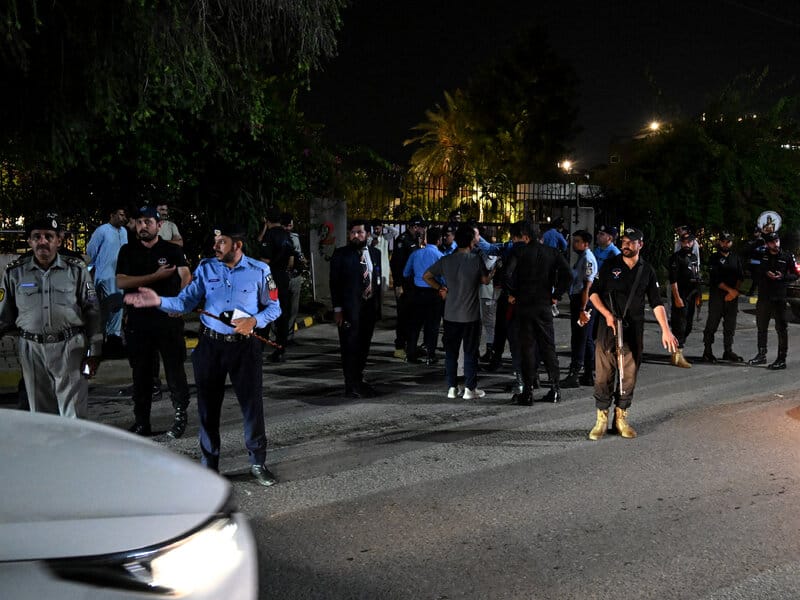
Tight security outside Islamabad hospital during Imran Khan’s medical visit (Source: The New York Times)
Imran Khan’s Medical Check-Up and Jail Return
On August 21, following the Supreme Court’s order, former Pakistan Prime Minister Imran Khan was transferred to Shifa Hospital in Islamabad for a detailed medical examination. The transfer took place under tight security, with hundreds of police personnel deployed around the hospital.
Dozens of Pakistan Tehreek-e-Insaf (PTI) supporters also gathered outside the facility during Khan’s brief stay. After undergoing a detailed medical examination by a team of doctors, Khan was declared medically fit and transferred back to Adiala Jail in Rawalpindi at approximately 5 a.m. on Friday, August 21.
“A team of qualified doctors, including an ophthalmologist, a cardiologist, and a physician, conducted a detailed examination of him and declared him medically fit. After the completion of this entire process, he was transferred back to Adiala Jail,” Pakistan’s Information Minister Attaullah Tarar wrote on X.
Pakistan’s Political Road Ahead
Khan’s brief hospital transfer is unlikely to end the wider political dispute surrounding his imprisonment. Instead, his return to Adiala Jail could keep tensions between his Pakistan Tehreek-e-Insaf (PTI) party and the government alive, particularly over his treatment and access to medical care.
Supreme Court’s intervention has also brought renewed attention to the relationship between Pakistan’s judiciary, government and powerful political establishment. With Khan continuing to command strong support among his followers and PTI planning further protests, his imprisonment remains a major source of political tension in the country. How the government and courts handle his legal and medical situation could therefore have wider implications for political stability and the future of opposition politics in Pakistan.