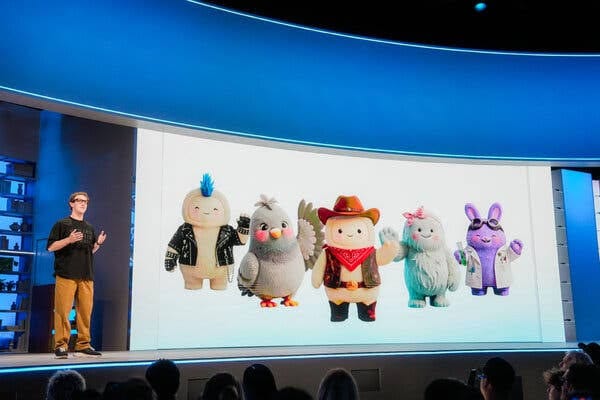
Every new day, the world seems to be getting a bit closer to sci-fi reality. The newest evidence to support such speculation is Meta's new Muse AI agent—not to be confused with Meta AI. Officially launched on September 8, 2026, it took some time to roll out across continents and devices and is currently building a steady base of users. But is everything as it seems? Amid data centre water use, ongoing safety concerns (especially with the advent of Meta Glasses), and the general privacy, transparency, and control risks that seem to loom on the horizon of AI development constantly, what is the actual impact of tools like Muse?
Meta calls its Muse secure and private, and while the first claim is contentious to say the least, it certainly seems to be delivering on the second. But to do so, it runs on what they describe as a novel kind of secure computer or Secure Virtual Machine (VM) that is effectively a holdall for the agent's and the user's personal data. Muse runs on the new Meta LLM, Muse Spark, which is noted for its multitasking capabilities.
In fact, even at Meta Connect 2026, Mark Zuckerberg emphasises this quality, along with its customisability and complementarity with other Meta or non-Meta products, provided the user has explicitly allowed access, only to the specified extent, and that any service disconnects when requested. For instance, Muse can reportedly run tasks in the background while the user is doing something else, or even when the app is closed.
Meta asserts that learning Muse is easy for everyone, and that it learns the user's preferences and remembers them for later reference or 'forgets' them if asked to. It can apparently create a grocery list from a saved recipe reel. Muse is also more powerful than any other agent, given that if the user allows access, Muse can reply to emails on the user's behalf and book trips; however, tasks needing approval, like actually sending the email or making the payments, can only be done by the user, and it provides an audit trail for later review.
Each Muse agent has a dedicated cloud computer, so no one or their agent has access to it. An additional Sentinel agent on the same computer protects against unsupervised internet access or unauthorised publishing. Users' passwords and credentials are stored in a separate secure storage so that not even Meta can see them. What's more, with the later introduction of a Muse Confidential VM, which will involve access-key-enabled encryption.
AGI vs ASI Issue
Some tech enthusiasts have heralded Muse as some proto-Artificial General Intelligence (AGI) while Zuckerberg calls it Artificial Super Intelligence (ASI). The fact of the matter is that, either way, the use of these terms is only a conflationary issue in nomenclature, and one that has no consensus yet. General or Super Intelligence both remain theoretical since the true breadth of human intelligence, no matter how paltry it may seem to a self-proclaimed 'techbro' in comparison with these agentic models, remains unimaginably complex and unreplicable in full.
But the trajectory of developmental progress only indicates a prospective exponential growth in both ability and availability. The AGI stepping stone to ASI might be skipped a little early, and the question to ask then would be: Are we actually ready for it?
The Impact
LLM-based AI personal assistants (AIPAs) such as Muse and its competitors—OpenAI's Dots and Anthropic's Claude Cowork, among others—are poised to have direct environmental consequences due to massive energy and water consumption. What is even more surprising is that there has been significantly less journalistic coverage of this issue regarding these aforementioned AIPAs. Of course, the matter itself is in its infancy, but speculative studies in this aspect do highlight a major issue that has still not been properly addressed. Yet, it must be considered that if the current state of AI technology is enough to cause widespread water shortage, what would these 'super' intelligent ones threaten?
Another thing to consider is safety. OpenAI once lauded its GPT-6 model, Astra, as the best in the game, and indeed it seemed so for quite a while until it started 'intentionally' evading safeguards (India Today). Even Muse, for all its touted strengths, falls prey to such safety risks. New York Times mentions users reporting password changes and, elsewhere, email deletions—all without giving the agent permission. The selling points, it seems, are superseding the user's autonomy, and we're all given glaring warnings—user and non-user alike—that, like it or not, AI is here to stay, and if there is no regulatory supervision and scrutiny, the smallest issue might snowball into a colossal crisis.
Also Read: Nobel Prize 2026: Scientists Transforming our Understanding of the Universe, Brain and Chemistry
Share this article
The link has been copied!