Three Years On, Pakistan Still Waits at BRICS' Door as India Holds the Veto
Pakistan's three-year wait for BRICS membership continues at the New Delhi summit, blocked by India's veto despite backing from China and Russia and a growing economic case.

Pakistan's three-year wait for BRICS membership continues at the New Delhi summit, blocked by India's veto despite backing from China and Russia and a growing economic case.
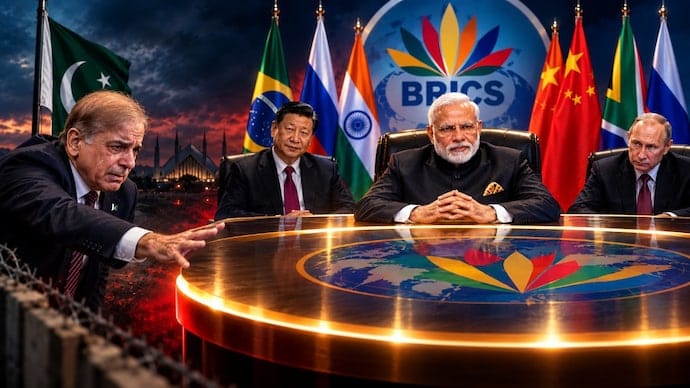
As leaders of eleven BRICS nations gather at Bharat Mandapam in New Delhi for the bloc's 18th summit, one regional player remains conspicuously outside the room: Pakistan. Islamabad first applied for membership in August 2023, and three years on, it is still waiting — with India's veto standing as the single biggest obstacle to its entry.
Pakistan's Foreign Ministry formally confirmed its bid in November 2023, months after BRICS opened its ranks to Egypt, Ethiopia, Iran, Saudi Arabia and the UAE, who joined in January 2024, followed by Indonesia in 2025. Because BRICS admits new members only by consensus, every one of the bloc's current states — Brazil, Russia, India, China, South Africa and the newer entrants must agree before Islamabad can join.
That single requirement has proved decisive. Russia has publicly backed Pakistan's bid, with Deputy Prime Minister Alexei Overchuk confirming Moscow's support in 2024, and China — Islamabad's closest ally and a fellow founding BRICS member has also lent its weight. Yet neither can override India's objection. New Delhi has repeatedly pointed to Pakistan's alleged support for cross-border terrorism, an issue that hardened further after the April 2025 Pahalgam attack that killed 26 people and prompted India's Operation Sindoor against terror infrastructure in Pakistan and Pakistan-occupied Kashmir.
Pakistan has tried to play down the repeated setbacks. In 2023, its Foreign Office said it had not made a “formal request,” even as officials simultaneously worked channels in Moscow to build support. As recently as July 2025, a Foreign Ministry spokesperson said Islamabad “remains serious about pursuing its membership” and would “persist with our efforts to become its full member.”
The appeal is largely economic. BRICS and its partner countries now account for roughly half the world's population and about 40 percent of global GDP, with intra-bloc trade crossing $1 trillion in 2025. For a country grappling with a debt-to-GDP ratio near 75 percent, sluggish growth of around 3 percent, and heavy reliance on IMF bailouts, membership holds out the promise of alternative financing and diversified trade — particularly through the BRICS-backed New Development Bank (NDB), which lends without the policy conditions the IMF attaches.
Pakistan has already moved to build ties short of full membership. According to a Nikkei Asia report, Islamabad purchased a stake worth roughly $580 million in the NDB in 2025 to diversify its financing sources. Its textile exports, which touched $17.88 billion in FY25, already send more than a fifth of that volume to BRICS-Plus economies, and its copper exports to China have grown to around $1 billion. India's own trade with BRICS nations has surged too with exports to the bloc rose 48.8 percent, from $64.3 billion to $95.7 billion, underlining just how much economic gravity the grouping now carries.
Pakistan is far from being the only nation stuck in this situation, Bangladesh put in an application in 2023 and then tried to turn to Russia for help in reviving their bid, as have about two dozen other nations, who have shown interest in becoming part of some type of association with BRICS. It must be pointed out that BRICS is not a free-trade zone, which means that despite Pakistan getting into the organization, it will still not have free trade across the member states because that depends on the competitiveness of the products and bilaterally agreements between the nations.
Also read- BRICS Summit 2026: Jaishankar urges BRICS to Strengthen Economic Security and Supply Chains
Explore our upcoming features, author interviews, and deep-dives into new policy reforms.