UPI Charges Above ₹2,000: New 0.4% Fee Explained
UPI payments above ₹2,000 will attract a new 0.4% fee on eligible merchant transactions from October 15, 2026. Here’s what the new rule means for users and merchants.

UPI payments above ₹2,000 will attract a new 0.4% fee on eligible merchant transactions from October 15, 2026. Here’s what the new rule means for users and merchants.
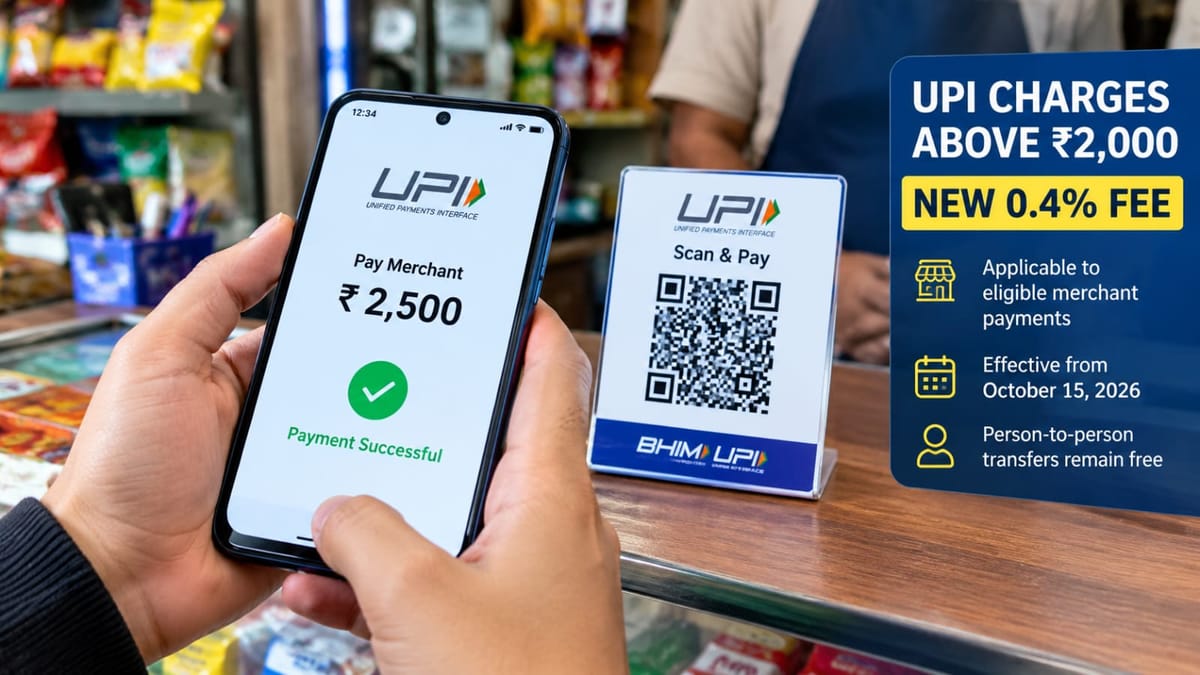
India’s Unified Payments Interface (UPI) is set for a major change from October 15, 2026. The National Payments Corporation of India (NPCI) has introduced a new Merchant Discount Rate (MDR) on certain UPI payments above ₹2,000 made to merchants.
The announcement has raised questions among UPI users about whether they will have to pay extra charges while making digital payments. However, the new rule does not mean that consumers will be charged for every UPI transaction above ₹2,000.
Under the new framework, a 0.4% MDR will apply to eligible Person-to-Merchant (P2M) UPI transactions above ₹2,000. The rule will come into effect from October 15, 2026.
MDR is a fee associated with processing certain merchant payments. The charge is not designed as a direct fee on customers making UPI payments.
For example, on an eligible merchant transaction of ₹10,000, the MDR at 0.4% would be ₹40. For transactions of ₹75,000 or more, the MDR will be capped at ₹300 per transaction.
The new MDR does not apply to person-to-person (P2P) UPI transfers. This means people can continue sending money to friends, family members or other individuals without paying the new charge.
The government has also clarified that the MDR should not be directly passed on to customers. Therefore, consumers should not assume that making a UPI payment above ₹2,000 will automatically result in an additional charge.
Small-value merchant payments of up to ₹2,000 will also remain free under the new system.
The new framework includes provisions for smaller merchants. Merchants receiving up to ₹1 lakh per month through UPI QR payments will remain exempt from the MDR.
This is significant for small shops, local businesses and vendors that depend on UPI payments for their daily transactions. The exemption is expected to limit the impact of the new fee structure on smaller businesses.
Certain essential services will have a separate MDR structure. For eligible payments above ₹2,000, sectors such as railways, telecom, insurance and fuel will attract a flat MDR of ₹5 instead of the standard 0.4% rate.
The separate structure is intended to account for the nature of these essential-service transactions.
UPI has become a major part of India’s digital payment system, with billions of transactions taking place every month. The introduction of MDR is expected to create a revenue stream for participants in the UPI ecosystem and help support payment infrastructure and related services.
The change will mainly affect eligible large-value merchant transactions. For ordinary users, person-to-person transfers and small merchant payments will continue without the new MDR.
With the new rules coming into force on October 15, consumers and merchants will need to understand the difference between merchant payments and person-to-person transfers to know when the new fee applies.
Also Read: BRICS Business Forum 2026: Iran and UAE on Women led Businesses
Explore our upcoming features, author interviews, and deep-dives into new policy reforms.