Why the World Cannot Afford to Ignore the Congo's Latest Ebola Outbreak
The DRC is facing its deadliest Ebola outbreak, driven by the rare Bundibugyo strain. With over 10,000 cases, the crisis is spreading to neighboring nations. Urgent global action is needed to support containment and accelerate vaccine trials before it becomes a global threat.
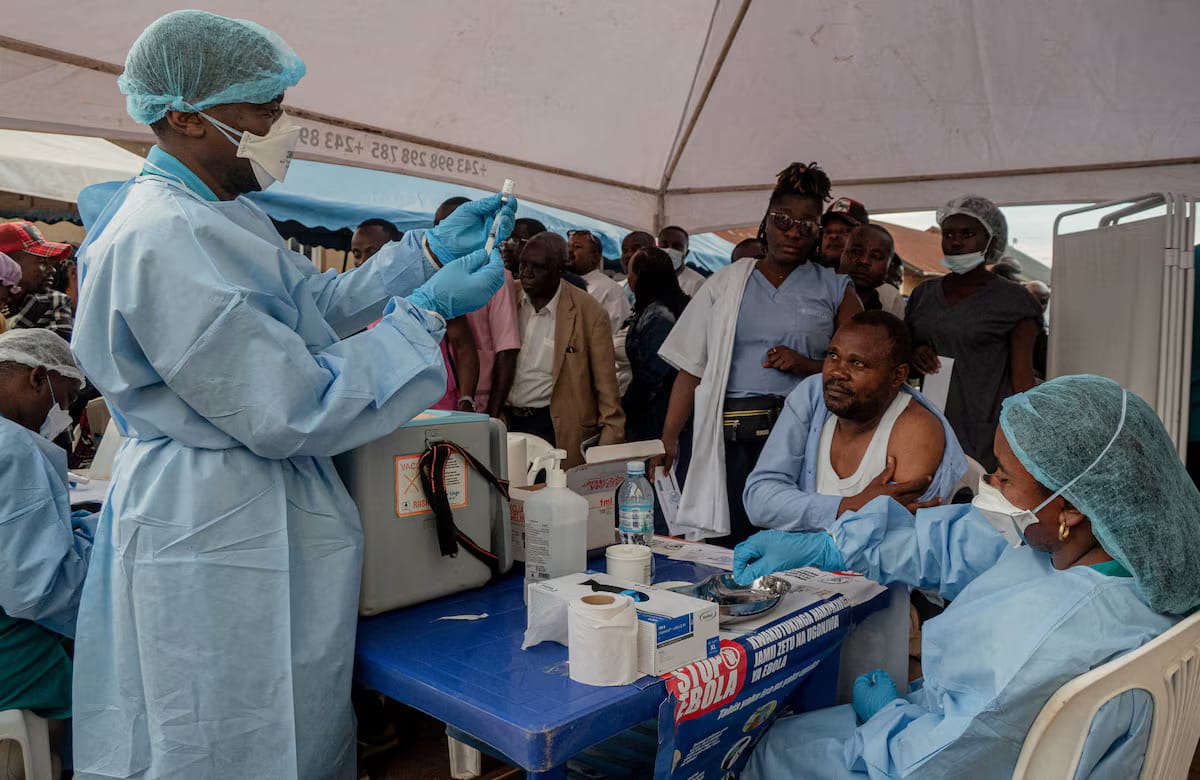
Health workers gather receive vaccines. Credit: Reuters
Health workers gather receive vaccines. Credit: Reuters
The Democratic Republic of the Congo (DRC) is currently facing its deadliest and fastest-growing Ebola outbreak in history. With confirmed cases surpassing 10,000 and nearly 4,900 deaths, the outbreak has become a cause for major global concern. The lessons of COVID-19 are pertinent thus: early action, international co-operation, and timely access to medical resources are essential to prevent local outbreaks from becoming global health emergencies.
A Rare and Dangerous Strain
This surge, first identified in May 2026, is driven by the rare Bundibugyo virus strain, for which there is currently no specialised medication. The situation is further complicated by the fact that many of the new cases are emerging from unknown chains of transmission. However, it is at least known that fruit bats and non-human primates are among the main agents of spreading.
Symptoms, the World Health Organisation (WHO) reports, include: fatigue, muscle pain, headache, sore throat, gastrointestinal symptoms, organ dysfunction, and haemorrhage.
The Threat of Regional Spread
With the latest reports estimating 10,060 cases and 4,887 deaths, this outbreak has already become the second-largest and second-deadliest epidemic in the region (Credit: Reuters).
The crisis is no longer confined to the DRC. Cases have already been reported from neighbouring countries, including Kenya and Nigeria, no doubt exacerbated by the high population mobility and porous borders. Uganda, however, has no reported cases and, in fact, has been Ebola-free since August, according to WHO. Further, the country is tightening its borders, increasing quarantine restrictions to curb the spread.
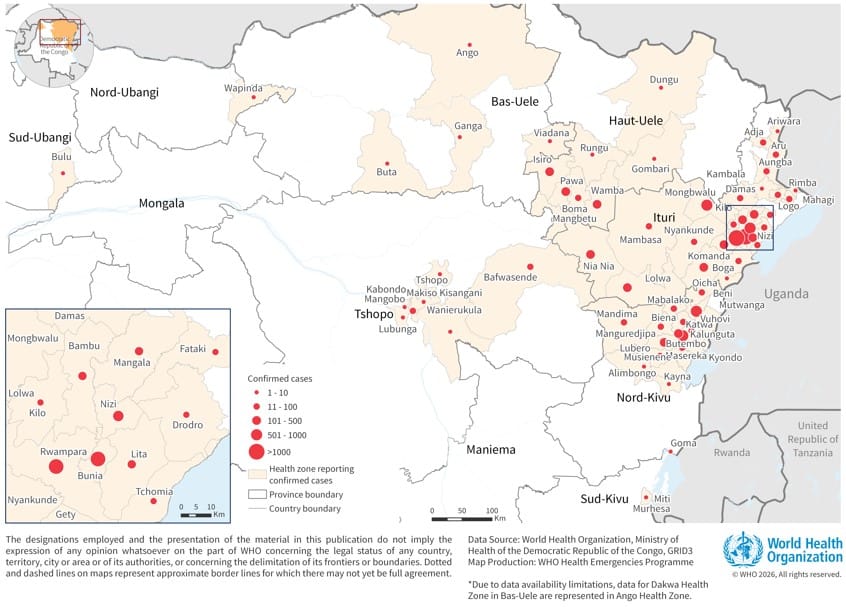
Distribution of cumulative confirmed cases of Bundibugyo virus disease in the DRC, as of 20 October 2026. Credit: WHO
Why Global Action is Needed Now
DRC and its adjoining areas suffer from insufficient medical resources as is, and to compound other deadly diseases like Malaria further complicates Ebola diagnosis, especially since many of the earlier symptoms may appear equivocal.
Efforts are still underway to develop protection against the virus, with Institut National de Recherche Biomédicale (INRB) and the University of Antwerp (Global Health Institute)'s Tumaini going into trial. Elsewhere, Moderna; University of Oxford and Serum Institute of India are also researching similar vaccine trials.
"Tumaini" means hope in Swahili.
Tumaini is an adaptive Phase 2/3 trial to protect against the Bundibugyo virus. It starts with Ervebo, followed by Bundibugyo-specific vaccine candidates.
The trial is led by DRC authorities and Africa CDC, alongside partners including… pic.twitter.com/VyPHDj1u3C
Ignoring this outbreak is not an option, given what we know about how fast exactly a virus spreads, mutates, and cripples entire countries. Without a robust, internationally supported response, the combination of active conflict in affected regions, public mistrust, and overwhelmed local healthcare systems could allow the virus to spiral out of control. Thus, global health security depends on stopping the virus at its source.