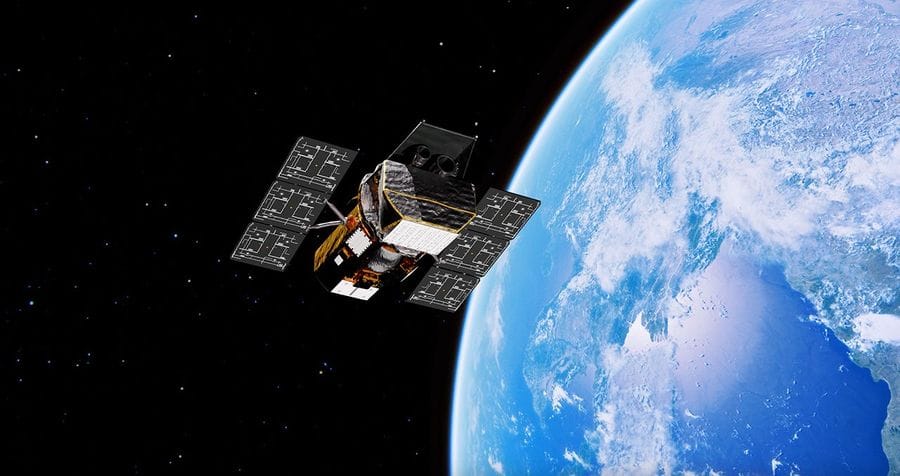
The Truth About India's Debris Risk As NASA Swift Makes Its Fiery Return
NASA's Swift Observatory is set to re-enter Earth's atmosphere after nearly 22 years in orbit. Most of the spacecraft is expected to burn up, but surviving debris could fall in parts of southern India. Find out about the re-entry timeline, potential debris locations and the actual risk to people.
NASA's Neil Gehrels Swift Observatory is set to re-enter Earth's atmosphere after nearly 22 years in orbit, raising concerns about space debris falling in India. While most of the spacecraft is expected to burn up during re-entry, some fragments could survive and reach Earth's surface, especially in parts of southern India. Yet the risks of harm from debris remain negligible.
What is NASA's Swift Observatory?
NASA's Neil Gehrels Swift Observatory is a space-based telescope launched on November 20, 2004, to study gamma-ray bursts (GRBs), which are usually among the most powerful explosions in the universe. Originally designed for a two-year mission, Swift operated for nearly 22 years (ending in October 2026), detecting more than 2,000 GRBs and contributing to research on supernovae, black holes, multi-wavelength observation, and other cosmic phenomena.
A Look into the Re-Entry
The spacecraft's orbit gradually declined due to atmospheric drag, which increases following heightened solar activity. As Swift moved closer to Earth, upper atmospheric resistance accelerated its descent.
NASA and Katalyst Space attempted to extend the observatory's operational life through a robotic spacecraft called LINK, designed to capture Swift and boost it into a higher orbit. However, technical problems prevented the rescue mission from reaching its target, and the attempt was abandoned in August 2026.
AP's Video on failed rescue mission for NASA Swift, and eventual re-entry. Credit: AP
According to NASA's November 2 update, the US Space Force estimated that Swift would re-enter Earth's atmosphere on November 4, 2026, at approximately 3:30 a.m. Easter Standard Time (14:00 IST), with an uncertainty of 11 hours.
Could the Debris Fall in India?
NASA expects most of the approximately 1,452 kg spacecraft to burn up as it passes through the Earth's atmosphere. However, some denser components could survive re-entry and reach the surface. Still, NASA estimates the actual risk of harm to be approximately 1 in 2,100, with surviving fragments likely to fall into the ocean rather than into populated areas.
Further, NASA predicts that the surviving fragments could fall within a latitude band extending from 20.6°S to 20.6°N, which includes parts of southern India, Africa, Southeast Asia, Australia, and South America.
NDTV thus says cities such as Mumbai, Hyderabad, Bengaluru, and Chennai could fall within this geographical band. However, no space research or air force agencies, nationally or internationally, have raised an alarm about debris impacts, and even the precise re-entry location remains uncertain.
NASA Swift satellite live tracking map showing its position at 14:30 (IST).Credit: Orbital Radar
For live tracking of the satellite's descent, readers can refer to Orbital Radar, N2YO, or other similar sites, as well as official bulletins by NASA and allied organisations.