India's Aditya-L1 Triumph: New Discovery About Solar Eruption Expansion
India’s Aditya-L1 solar mission has revealed that coronal mass ejections do not always expand uniformly as they travel through space. The discovery by researchers at the Indian Institute of Astrophysics could help improve our understanding of solar eruptions and enhance space-weather forecasting.
India's Aditya-L1 solar mission has detected uneven expansion in a coronal mass ejection (CME), offering new insights into how solar eruptions travel through space. The discovery, made by researchers at the Indian Institute of Astrophysics (IIA), Bengaluru, could help improve scientists' understanding of solar activity and space-weather forecasting.
What was the Aditya-L1 Mission?
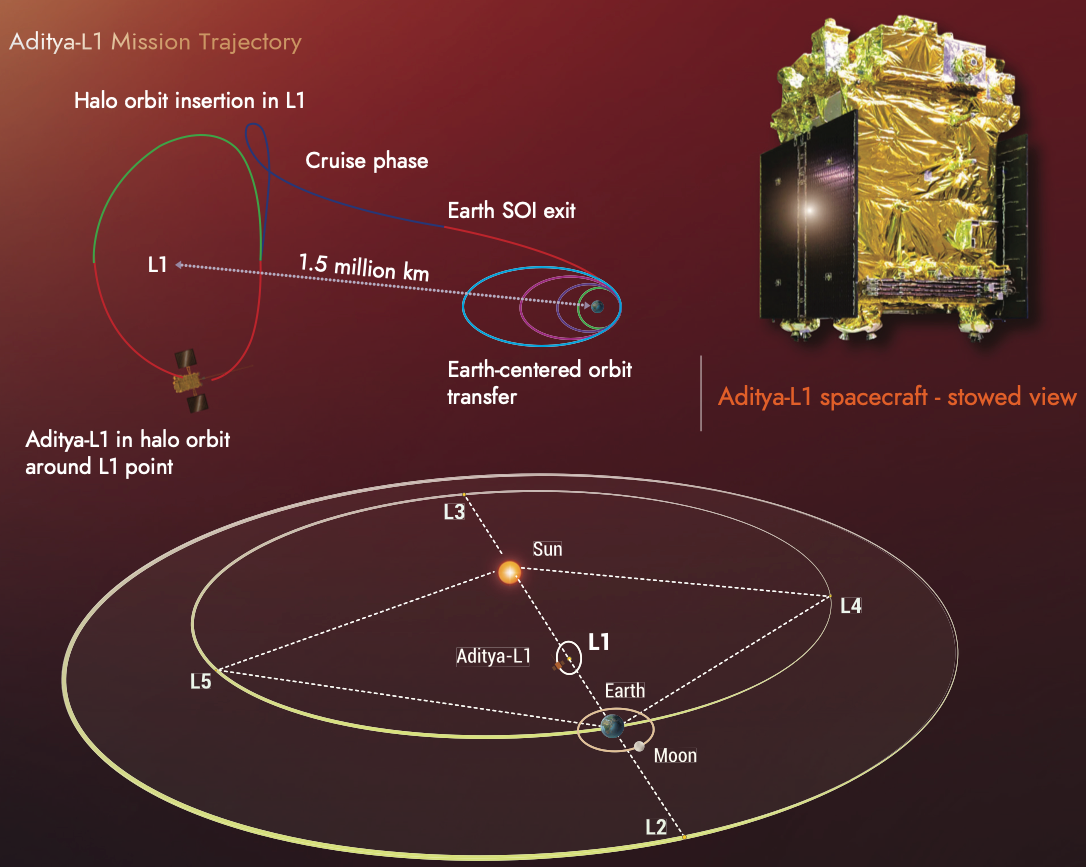
Aditya-L1 is India's first space-based solar observatory, launched by ISRO on September 2, 2023. Positioned in a halo orbit around the Sun-Earth Lagrange Point 1 (L1), approximately 1.5 million kilometres from Earth, the spacecraft studies the Sun continuously. Its objectives include examining the solar corona, solar wind, solar flares, and CMEs.
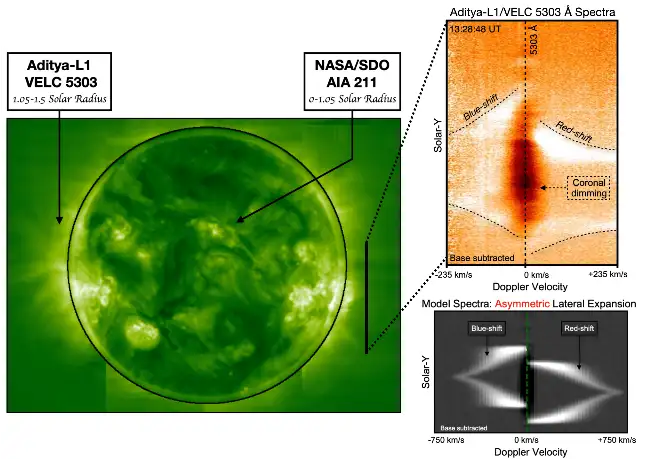
Aditya L1's recent findings were developed out of a combination of data from Aditya-L1’s Visible Emission Line Coronagraph (VELC), NASA’s Solar Dynamics Observatory (SDO), and advanced 3D modelling. (Credit: DD News)
What is Solar Eruption Expansion?
Solar eruptions are sudden releases of energy and material from the Sun's atmosphere. One major type is CME, which involves large quantities of plasma and magentic field sbeign expelled into space. As a CME travels away from the Sun, it expands in size. Scientists often study this expansion to understand its direction, speed, and potential impact on Earth.
Aditya-L1 observations revealed that this expansion was not always uniform. Instead of expanding symmetrically, the observed CME developed an asymmetric structure, with different sections expanding at different rates.
What Does This Mean for Space Research?
The discovery could help scientists improve their understanding of CMEs and their movement through space. Since uneven expansion can affect a CME's speed, direction, and arrival time, studying these variations may improve space-weather forecasting. This is particularly important for assessing potential disruptions to satellites, communication systems, and other space-based infrastructure. (Credit: News On Air)